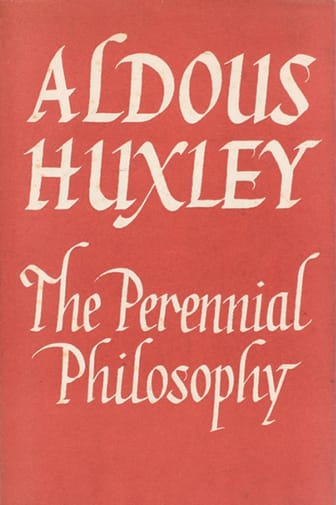
Title details
Original Publication Date:1945
Edition Reviewed:Chatto & Windus, 1947
Print Length:344 pages
The Perennial Philosophy
By Aldous Huxley
Excerpt
Excerpt
“The Perennial Philosophy is primarily concerned with the one, divine Reality substantial to the manifold world of things and lives and minds. But the nature of this one Reality is such that it cannot be directly and immediately apprehended except by those who have chosen to fulfil certain conditions, making themselves loving, pure in heart, and poor in spirit. Why should this be so? We do not know. It is just one of those facts which we have to accept, whether we like them or not and however implausible and unlikely they may seem. […]
When poets or metaphysicians talk about the subject matter of the Perennial Philosophy, it is generally at second hand. But in every age there have been some men and women who chose to fulfil the conditions upon which alone, as a matter of brute empirical fact, such immediate knowledge can be had; and of these a few have left accounts of the Reality they were thus enabled to apprehend […] To such first-hand exponents of the Perennial Philosophy those who knew them have generally given the name of ‘saint’ or ‘prophet,’ ‘sage’ or ‘enlightened one.’ And it is mainly to these, because there is good reason for supposing that they knew what they were talking about, and not to the professional philosophers or men of letters, that I have gone for my selections.”
Essence
Essence
Across centuries and traditions, the same discovery keeps being made: that the divine Ground can be directly known – but only by those willing to fulfil the conditions.
Aldous Huxley’s The Perennial Philosophy is an anthology of mystical writing drawn from across the world’s great traditions – the Upanishads, the Tao Te Ching, Meister Eckhart, the Sufi poets, The Cloud of Unknowing, the Bhagavad-Gita, Zen masters, and dozens more – arranged and connected by Huxley’s own commentary into a single keynote. Beneath the apparently irreconcilable differences of the world’s religions lies one and the same metaphysical discovery: that there is a divine Ground of all existence, that the human soul is made of the same substance as this Ground, and that the final purpose of human life is to know this Ground directly and unitively. This knowledge cannot be had by reading or reasoning alone. It is available only to those who have fulfilled certain conditions: dying to “selfness,” practising non-attachment, cultivating charity, and living with one-pointed awareness. What Huxley illuminates is the “Highest Common Factor” of all great religions: the perennial philosophy that remains once the dogmas, rites, and institutional forms are set aside.
Embodiment: Living the Wisdom
Embodiment: Living the Wisdom
The Perennial Philosophy opens with a deceptively simple premise: “Knowledge is a function of being. When there is a change in the being of the knower, there is a corresponding change in the nature and amount of knowing.” You cannot know more than you are. The astronomer with a sixty-inch reflector sees more than the naked-eye observer, not because they possess different data but because they have modified their instrument. In the same way, the saint or mystic perceives aspects of Reality inaccessible to the average person because they have done the work of self-modification. For most of us, it is not that mystical experience is unavailable – it is unprepared for.
The book’s central teaching is that the Atman, the eternal Self within each being, is identical with Brahman, the absolute Ground of all existence. Huxley demonstrates this not by assertion but by weight of independent witness: Shankara’s Vedanta, the Chandogya Upanishad’s salt-in-water parable, Chuang Tzu, the Lankavatara Sutra, Meister Eckhart, William Law, the Quakers – the same discovery made across centuries and cultures, in entirely different vocabularies. It is much harder to dismiss so many independent traditions than to dismiss one.
What stands in the way of this discovery for so many of us? What we call ‘personality.’ “Selfness” – its Saxon equivalent – is the final obstacle to unitive knowledge. The saint is not someone with a better personality; the saint is someone who has progressively dissolved the separative self until what remains is not a private person but a conduit for divine energy. This is why genuine saints, drawn from entirely different temperaments and traditions, end up remarkably similar: selfless, undivided, universally charitable.
True charity, Huxley is careful to show, is not warmth or sentiment but something disinterested, tranquil, directed not by feeling but by will – and it is this quality of love, purified of self, that he considers the most powerful force available to a human being. “Love is infallible; it has no errors, for all errors are the want of love,” writes William Law, the eighteenth-century English mystic whose work Huxley returns to more than almost any other source in the book. The work of purifying that love – what Huxley calls mortification – is not about physical austerity but the patient acceptance of whatever life brings, borne without self-pity.
Huxley is equally sharp on the difference between knowing about the truth and knowing it directly. Organised religion has persistently mistaken verbal assent for direct experience – treating theological formulae as if agreeing to words were the same as contact with what the words point toward. “To suppose that people can be saved by studying and giving assent to formulae is like supposing that one can get to Timbuctoo by poring over a map of Africa.” Fittingly, Huxley applies this position to The Perennial Philosophy itself: remember it is also a map, not the territory.
The goal, finally, is not escape from the world but what Huxley calls “knowledge in the fullness”: the direct awareness of the divine Ground both within and without – in nature, in other beings, in the ordinary events of work and relationship. The Zen masters and the Taoist cooks, the saints walking back into the world after enlightenment – these are his models: fully engaged, fully present, and inwardly free.
For those of us who are not yet sage or saint, Huxley is characteristically practical about where to begin. The best thing one can do “is to study the works of those who were… capable of a more than merely human kind and amount of knowledge”; i.e., those enlightened ones who “modified their merely human mode of being.” This anthology is itself that study – and the voices gathered within it are among the finest guides available.

“We can only love what we know, and we can never know completely what we do not love. Love is a mode of knowledge, and when the love is sufficiently disinterested and sufficiently intense, the knowledge becomes unitive knowledge and so takes on the quality of infallibility.”