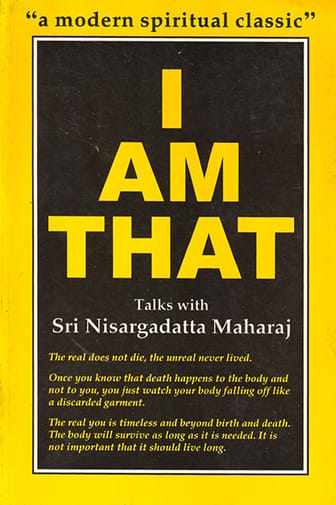
Title details
Original Publication Date:1973
Edition Reviewed:The Acorn Press, 1988
Translator:Maurice Frydman
Editor:Sudhakar S. Dikshit
Print Length:550 pages
I Am That
By Sri Nisargadatta Maharaj
Excerpt
Excerpt
“Q: What benefit is there in knowing that I am not the body?
M: Even to say that you are not the body is not quite true. In a way you are all the bodies, hearts and minds and much more. Go deep into the sense of ‘I am’ and you will find. How do you find a thing you have mislaid or forgotten? You keep it in your mind until you recall it. The sense of being, of ‘I am’ is the first to emerge. Ask yourself whence it comes, or just watch it quietly. When the mind stays in the ‘I am’, without moving, you enter a state which cannot be verbalized but can be experienced. All you need to do is to try and try again. After all the sense ‘I am’ is always with you, only you have attached all kinds of things to it — body, feelings, thoughts, ideas, possessions etc. All these self-identifications are misleading. Because of them you take yourself to be what you are not.
Q: Then what am I?
M: It is enough to know what you are not. You need not know what you are. For, as long as knowledge means description in terms of what is already known, perceptual, or conceptual, there can be no such thing as self-knowledge, for what you are cannot be described.”
Essence
Essence
Hold to ‘I am’ until it dissolves into the awareness that was there before it ever arose.
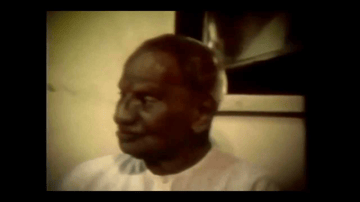
A humble man with an extraordinary depth of insight, Sri Nisargadatta Maharaj ran a small shop in a Bombay backstreet – an ordinary life until, in his thirties, a friend took him to meet Sri Siddharameshwar Maharaj of the Navnath Sampradaya. Given a simple instruction, to hold to the sense ‘I am’ and trust it completely, he realised his true nature within a few years, and for the rest of his life, disciples and seekers found their way to his small room to put their questions to him directly. I Am That collects 101 of these conversations, and its method never changes: rather than tell you what the true Self is, Maharaj shows you, again and again, what it is not – not the body, not the mind, not any thought, memory, or role you have taken yourself to be. A visitor asks something specific – about death, about suffering, about God, about the state of the world – and Maharaj answers only by stripping away another layer of false identity, until what remains is the one fact no one can doubt: the sense of being, ‘I am.’ Even that, he insists, is not the final answer, only the last concept before the Absolute – and the whole of his teaching is the instruction to sit with ‘I am’, trust it, and let it carry you into the awareness that was never born and will never die. In the decades since its publication, I Am That has become a modern spiritual classic, embraced by spiritual teachers and seekers alike, beloved for its lucidity and transformative power.
Embodiment: Living the Wisdom
Embodiment: Living the Wisdom
I Am That is built entirely from dialogue, and its form carries its method: each of the 101 talks records a conversation with a visitor, and Maharaj always answers by pointing back to the sense of being, however far afield the question first appears to go. A short exchange early in the book illustrates the pattern:
“M: The mind, by its very nature, divides and opposes. Can there be some other mind, which unites and harmonizes, which sees the whole in the part and the part as totally related to the whole?
Q: The other mind — where to look for it?
M: In the going beyond the limiting, dividing and opposing mind. In ending the mental process as we know it. When this comes to an end, that mind is born.
Q: In that mind, the problem of joy and sorrow exist no longer?
M: Not as we know them, as desirable or repugnant. It becomes rather a question of love seeking expression and meeting with obstacles. The inclusive mind is love in action, battling against circumstances, initially frustrated, ultimately victorious.
Q: Between the spirit and the body, is it love that provides the bridge?
M: What else? Mind creates the abyss, the heart crosses it.”
The exchange moves through three questions – about another kind of mind, about joy and sorrow, about what bridges spirit and body – before arriving at one of the book’s most quoted lines. That pattern, each answer opening onto the next, deeper question until the visitor’s own words come back to him transformed, is typical of how Maharaj works throughout.
He is just as direct when a visitor asks him to save the world: “Which world do you want to save? The world of your own projection? Save it yourself… What business have you with saving the world, when all the world needs is to be saved from you? Get out of the picture and see whether there is anything left to save.” It is the same manoeuvre he uses on grief, on death, on God: refusing the question as posed and sending the visitor back to examine who is asking it.
The practice underneath all of this is what his translator Maurice Frydman named Nisarga Yoga, the “natural yoga” of Maharaj. It is described in the book’s appendix as “disconcertingly simple — the mind... must recognize and penetrate its own being, not as being this or that, here or there, then or now, but just timeless being.” Maharaj’s own instructions are just as plain: sustain the sense ‘I am,’ “Be with it all the time you can spare, until you revert to it spontaneously. There is no simpler and easier way,” until it becomes, in his words, “a persistent attempt to cross over from the verbal to the non-verbal.” He describes the witness who watches thought and feeling as “the watch-tower of the real, the point at which awareness, inherent in the unmanifested, contacts the manifested,” and insists that even this witnessing must eventually dissolve, since ‘I am’ is the last concept before the Absolute, not the Absolute itself. Nothing in his telling is abstract: he tests every claim against his own direct experience, never against scripture or borrowed authority.
Readers who would like the teaching in a more concentrated or contextualised form can turn to the book’s own appendices: Frydman’s account of Nisarga Yoga (Appendix I) distils the method in a few pages, and ‘Navnath Sampradaya’ (Appendix II) sets Maharaj’s teaching within the wider lineage he belonged to.

“Love says: ‘I am everything’. Wisdom says: ‘I am nothing’. Between the two my life flows.”