Title details
Original Publication Date:1964
Edition Reviewed:HarperPerennial, 1997
Editor:D. Rajagopal
Print Length:272 pages
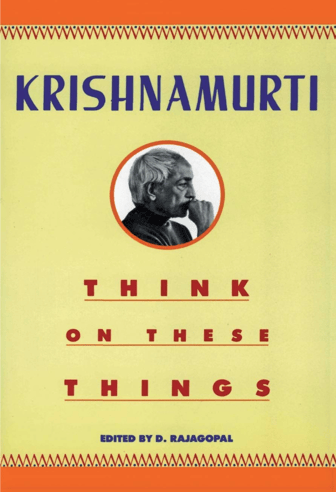
Think on These Things
By J. Krishnamurti
Experience the Book
Think on These Things
jkrishnamurti.orgExcerpt
Excerpt
“Creativeness has its roots in the initiative which comes into being only when there is deep discontent.
Don’t be afraid of discontent, but give it nourishment until the spark becomes a flame and you are everlastingly discontented with everything—with your jobs, with your families, with the traditional pursuit of money, position, power—so that you really begin to think, to discover. But as you grow older you will find that to maintain this spirit of discontent is very difficult. You have children to provide for and the demands of your job to consider; the opinion of your neighbours, of society closing in upon you, and soon you begin to lose this burning flame of discontent. When you feel discontented you turn on the radio, you go to a guru, do puja, join a club, drink, run after women—anything to smother the flame. But, you see, without this flame of discontent you will never have the initiative which is the beginning of creativeness. To find out what is true you must be in revolt against the established order; but the more money your parents have, and the more secure your teachers are in their jobs, the less they want you to revolt.
Creativeness is not merely a matter of painting pictures or writing poems, which is good to do, but which is very little in itself. What is important is to be wholly discontented, for such total discontent is the beginning of the initiative which becomes creative as it matures; and that is the only way to find out what is truth, what is God, because the creative state is God.
So one must have this total discontent—but with joy. Do you understand?”
Essence
Essence
See how your mind has been conditioned not to know truth.
You are being educated to fit in. That is J. Krishnamurti's opening provocation, and the thread that is followed across this edited collection of his talks. Characteristic of Krishnamurti, he is not interested in giving you a better system of belief or a more refined philosophy. His single insistence is this: the mind conditioned by authority, tradition, and the compulsion to become something cannot see clearly – and it is clear seeing, not effort or imitation, that transforms. It lands all the more powerfully given that he himself renounced the mantle of sacred authority. Raised and anointed the next ‘World Teacher’ by leaders of the Theosophical Society when he was only 14, he would – at the age of 29 – dissolve the Order that was set up for him. Working through education, ambition, fear, relationship, attention, and love, Krishnamurti returns again and again to the same interlocking points: intelligence is not knowledge, freedom is not independence, and love is not attachment. The work's rhythm is inquiry – questions asked, assumptions overturned, the reader brought back, each time, to the immediacy of their own mind.
Embodiment: Living the Wisdom
Embodiment: Living the Wisdom
Think on These Things is a work of creative disruption and J. Krishnamurti's target is the settled mind – the mind that has accepted its education, its tradition, its gods, and called it living. What he points toward instead is a quality of attention that refuses to settle for the secondhand. It is, he suggests, already available to you in the smallest things. Have you ever listened to the ringing of temple bells and noticed the silence between the notes? “If there were no silence, would there be notes? And if you listened to the silence, would not the notes be more penetrating, of a different quality?” This is what he means by attention: not the narrowing of the mind onto one thing, blocking everything else out, but an awareness so open it takes in the bell and the silence at once – without effort or resistance.
The obstacle to this attention is what we do instead. Krishnamurti offers an image of a pool that is disconnected from the river. We dig a little space of security – our habits, our identities, our certainties – and in that pool, he says, we stagnate and call it existence, while the river, “full of life and vitality, flows swiftly along.” What he asks is simply this: can you see that you are in the pool? Not in order to escape it through effort or discipline – but because that clear seeing is itself freedom: “So freedom lies, not in trying to become something different, nor in doing whatever you happen to feel like doing, nor in following the authority of tradition, of your parents, of your guru, but in understanding what you are from moment to moment.”
When that attention is present, learning becomes something entirely different. It is no longer the accumulation of information or the mastery of a subject. “When you are really learning you are learning throughout your life and there is no one special teacher to learn from. Then everything teaches you—a dead leaf, a bird in flight, a smell, a tear, the rich and the poor, those who are crying, the smile of a woman, the haughtiness of a man… Life itself is your teacher, and you are in a state of constant learning.” To be, as he puts it, “constantly learning, never concluding.”
Then there is love. Not spiritual love, nor romantic love, but what he calls “just love, being tender, really gentle in one’s whole approach to all things” – a sensitivity toward flowers, animals, people, and life that has no room for ambition or cruelty. He has a characteristically direct way of putting the problem: we spend our lives wanting to be loved, he says, without noticing that the wanting itself is the absence of love. “You want to be loved because you do not love; but the moment you love, it is finished, you are no longer inquiring whether or not somebody loves you.” Freedom, attention, and love are not three separate achievements – without any one of them, the others cannot fully be.
Those wishing to go deeper into the work of Krishnamurti, and indeed themselves, will find an active programme of group retreats, silent weekends, and self-directed stays – with no teacher, no authority, and no imposed structure – at the Krishnamurti Centre at Brockwood Park in England. The Krishnamurti Foundation of America offers free monthly dialogues, online study programmes on themes of freedom and conditioning, and an annual open gathering – all designed, as Krishnamurti himself insisted, not to give you answers but to put you in honest contact with your own questions.

“The moment we want to be something, we are no longer free.”