Title details
Original Publication Date:1975
Edition Reviewed:New York Review Books (NYRB) Classics, 2009
Translator:Larry Korn, Chris Pearce, Tsune Kurosawa
Print Length:200 pages
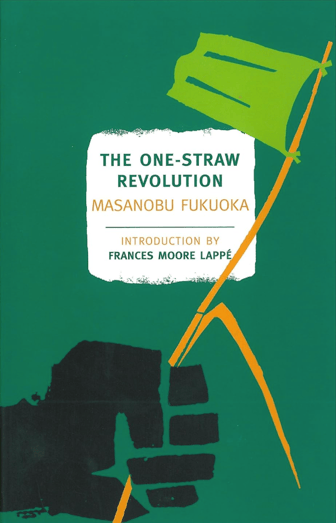
The One-Straw Revolution
An Introduction to Natural Farming
By Masanobu Fukuoka
Excerpt
Excerpt
“One night as I wandered, I collapsed in exhaustion on a hill overlooking the harbor, finally dozing against the trunk of a large tree. I lay there, neither asleep nor awake, until dawn … As the breeze blew up from below the bluff, the morning mist suddenly disappeared. Just at that moment a night heron appeared, gave a sharp cry, and flew away into the distance. I could hear the flapping of its wings. In an instant all my doubts and the gloomy mist of my confusion vanished. Everything I had held in firm conviction, everything upon which I had ordinarily relied was swept away with the wind.
I felt that I understood just one thing. Without my thinking about them, words came from my mouth: ‘In this world there is nothing at all.’ … I felt that I understood nothing. I could see that all the concepts to which I had been clinging, the very notion of existence itself, were empty fabrications. My spirit became light and clear. I was dancing wildly for joy. I could hear the small birds chirping in the trees, and see the distant waves glistening in the rising sun. The leaves danced green and sparkling. I felt that this was truly heaven on earth.
[…] I think it would safely be said that from the experience of that morning my life changed completely. Despite the change, I remained at root an average, foolish man, and there has been no change in this from then to the present time. But the assurance that I know this one thing has not changed since that time.”
Essence
Essence
From just one straw a revolution can begin – a revolution that returns us to nature's wisdom and reveals that the answer to our problems is not more doing, but less.
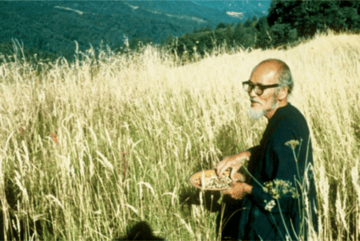
The One-Straw Revolution is Masanobu Fukuoka’s testament to forty years of natural farming in Japan, but its influence has spread far beyond the realm of agriculture. After a mystical awakening at age twenty-five, Fukuoka quit his position as an agricultural scientist and returned to his family’s land, determined to test his radical insight: that nature is perfect and cannot be improved by human intervention. Much more than a farming manual, the work is a concise philosophical manifesto challenging our assumptions about scientific knowledge, technological progress, and our relationship with the living world. Fukuoka demonstrates that truly successful farming requires “not so much arduous labor as awareness, observation, connection, and persistence.” His message, radical in 1975 and even more urgent today, cuts to the heart of how we all live. Whether you tend a field or a window box, shop for food, or simply walk on this earth, Fukuoka makes the case for trusting nature’s abundance and letting go of fear-driven control. The One-Straw Revolution is a direct and practical call for us all to consider our relationship to nature, our role in modern agricultural practices, and our agency to choose to live simpler, happier lives.
Embodiment: Living the Wisdom
Embodiment: Living the Wisdom
Fukuoka’s natural farming technique emerges from direct realisation rather than theory. His four principles dismantle modern agriculture’s assumptions. First, no ploughing: “The earth cultivates itself naturally by means of the penetration of plant roots and the activity of microorganisms, small animals, and earthworms.” Second, no fertiliser: “If left to itself, the soil maintains its fertility naturally, in accordance with the orderly cycle of plant and animal life.” Third, no weeding: “Weeds play their part in building soil fertility and in balancing the biological community.” Fourth, no chemicals: “Nature, left alone, is in perfect balance.” Each principle removes unnecessary human intervention, allowing nature’s intelligence to flourish.
This “do-nothing” approach naturally arises from a fundamentally different relationship to knowledge than what is common amongst modern scientists. As a trained plant pathologist who spent years isolating disease-causing fungi, Fukuoka realised firsthand the limits of scientific thinking: “Nature as grasped by scientific knowledge is a nature which has been destroyed; it is a ghost possessing a skeleton, but no soul.” Science fragments wholeness into isolated parts, creating problems it then claims to solve – what Fukuoka calls "learned ignorance."
To those who do not farm, Fukuoka is equally direct: “Consumers generally assume that they have nothing to do with causing agricultural pollution” – but it is consumer demand for large, shiny, perfectly shaped produce that drives chemical use. The most immediate application of this wisdom, for anyone with or without land, is choosing seasonal, local, imperfect food. Fukuoka describes how a slightly shrivelled piece of fruit, holding its energy at a low simmer like “a person in meditation,” actually preserves its food value far longer than chemically treated, cosmetically perfect produce. To choose otherwise is to unknowingly participate in the very system we may wish to resist.
Fukuoka's further advice for non-farmers includes growing food in any available space without chemicals or cultivation (even a small garden or balcony), supporting farmers practicing natural methods, questioning the assumption that more knowledge and technology improves life, and cultivating ‘do-nothing’ awareness that trusts nature's processes rather than constantly intervening to improve or control.
At the deepest level, Fukuoka addresses human consciousness itself. “In nature, the world of relativity does not exist.” Our concepts of strong and weak, good and bad, attack and defence create the very conflicts we then struggle against. “The act of defence is already an attack.” True peace lies in returning to “the heart of non-active nature. That is, sharpening the sickle instead of the sword.” Ultimately, Fukuoka's work is a clarion call for the wisdom of simplicity: stop indulging “fast rather than slow,” “more rather than less,” and “the desire for material possessions and personal gain.” Move instead “toward spiritual awareness” – one straw, one season, one simple choice at a time.

“When it is understood that one loses joy and happiness in the attempt to possess them, the essence of natural farming will be realized. The ultimate goal of farming is not the growing of crops, but the cultivation and perfection of human beings.”