Title details
Original Publication Date:1975
Edition Reviewed:Shambhala Publications, 1975
Print Length:330 pages
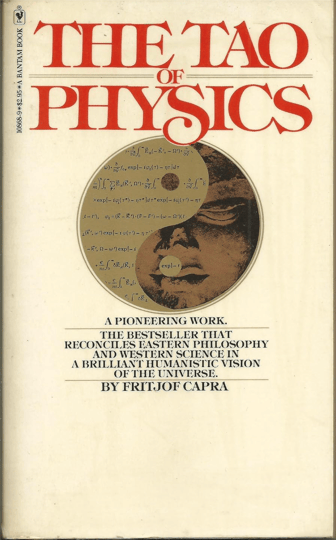
The Tao of Physics
By Fritjof Capra
Excerpt
Excerpt
“The basic elements of the Eastern world view are also those of the world view emerging from modern physics. They are intended to suggest that Eastern thought and, more generally, mystical thought provide a consistent and relevant philosophical background to the theories of contemporary science; a conception of the world in which man’s scientific discoveries can be in perfect harmony with his spiritual aims and religious beliefs. The two basic themes of this conception are the unity and interrelation of all phenomena and the intrinsically dynamic nature of the universe. The further we penetrate into the submicroscopic world, the more we shall realize how the modern physicist, like the Eastern mystic, has come to see the world as a system of inseparable, interacting and ever-moving components with man being an integral part of this system. The organic, ‘ecological’ world view of the Eastern philosophies is no doubt one of the main reasons for the immense popularity they have recently gained in the West, especially among young people. In our Western culture, which is still dominated by the mechanistic, fragmented view of the world, an increasing number of people have seen this as the underlying reason for the widespread dissatisfaction in our society, and many have turned to Eastern ways of liberation.”
Essence
Essence
Eastern and mystical traditions have long offered paths to understanding your essential nature; modern physics now offers a holistic path of its own.
Dr Fritjof Capra trained for years as a high-energy particle physicist before one afternoon he had an experience on a beach that would propel him to write his first book, the ground-breaking classic The Tao of Physics. On that beach, watching the waves roll in and feeling the rhythm of his breath, he experienced the physics of his own research – particle showers, colliding fields – as motion, and recognised it as the cosmic Dance of Shiva. That transcendent vision became the impetus for Capra to set the language of quantum theory beside the language of Hindu, Buddhist, and Taoist philosophies, and see where the two converge. As he demonstrates in The Tao of Physics, all of these worldviews arrive at the same discovery – that nothing in the universe holds still or stands apart: “The cosmos is seen as one inseparable reality—forever in motion, alive, organic; spiritual and material at the same time.” Published in 1975, The Tao of Physics helped to usher in an era of exploration and integration between Western science and Eastern philosophy that continues to animate the hearts and minds of so many who seek a fuller understanding of the world and how we move within it.
Embodiment: Living the Wisdom
Embodiment: Living the Wisdom
In The Tao of Physics, Dr Fritjof Capra does not ask you to take mysticism on faith any more than he asks you to take physics on faith – both, he explains, rest on direct, repeatable experience. He is candid from the outset about the limitations of the text and his hopes for the reader: they “may feel a certain lack of balance between the presentation of scientific and mystical thought. Throughout the book, his or her understanding of physics should progress steadily, but a comparable progression in the understanding of Eastern mysticism may not occur. This seems unavoidable, as mysticism is, above all, an experience that cannot be learned from books. A deeper understanding of any mystical tradition can only be felt when one decides to become actively involved in it. All I can hope to do is to generate the feeling that such an involvement would be highly rewarding.” Capra structures the text in three movements – The Way of Physics, The Way of Eastern Mysticism, and The Parallels. In so doing, he introduces each language – that of physics and that of Eastern mysticism – separately before he invites you to hear them as one.
A key teaching is that physics, pushed far enough, runs beyond the concepts we normally think with: “Probing inside the atom and investigating its structure, science transcended the limits of our sensory imagination. From this point on, it could no longer rely with absolute certainty on logic and common sense.” Capra’s message is not that mysticism ultimately disproves or transcends science, but that both now meet the same wall: a reality that no fixed concept can fully hold. He illustrates this limitation through the Hindu term ‘Maya’, itself a concept that can be misunderstood: “Maya… does not mean that the world is an illusion, as is often wrongly stated. The illusion merely lies in our point of view, if we think that the shapes and structures, things and events, around us are realities of nature, instead of realizing that they are concepts of our measuring and categorizing minds. Maya is the illusion of taking these concepts for reality, of confusing the map with the territory.”
To ground this into everyday life, consider the same gap between concept and direct experience that is at work in a joke: “In the split second where you understand a joke you experience a moment of ‘enlightenment.’ It is well known that this moment must come spontaneously, that it cannot be achieved by ‘explaining’ the joke, i.e. by intellectual analysis. Only with a sudden intuitive insight into the nature of the joke do we experience the liberating laughter the joke is meant to produce. The similarity between a spiritual insight and the understanding of a joke must be well known to enlightened men and women, since they almost invariably show a great sense of humour. Zen, especially, is full of funny stories and anecdotes, and in the Tao Te Ching we read, ‘If it were not laughed at, it would not be sufficient to be Tao.’”
While no fixed concept can fully hold reality, physicists have also discovered no observer can stand fully outside of it: “In atomic physics… the scientist cannot play the role of a detached objective observer, but becomes involved in the world he observes to the extent that he influences the properties of the observed objects. […] The idea of ‘participation instead of observation’ has been formulated in modern physics only recently, but it is an idea which is well known to any student of mysticism.” For physicists, the exploration of this “participatory universe” is the ramp towards the mystical understanding of the unity of all things – the fundamental oneness.
While the scientific and mystical approaches operate in very different frameworks, Capra’s position is that it is their integration that is necessary: “I see science and mysticism as two complementary manifestations of the human mind; of its rational and intuitive faculties. […] both of them are necessary, supplementing one another for a fuller understanding of the world. To paraphrase an old Chinese saying, mystics understand the roots of the Tao but not its branches; scientists understand its branches but not its roots. Science does not need mysticism and mysticism does not need science; but man needs both.”

“If physics leads us today to a world view which is essentially mystical, it returns, in a way, to its beginning, 2,500 years ago. […] In its most recent stages, Western science is finally… coming back to those of the early Greek and the Eastern philosophies. This time, however, it is not only based on intuition, but also on experiments of great precision and sophistication, and on a rigorous and consistent mathematical formalism.”