Title details
Original Publication Date:1975
Edition Reviewed:Beacon Press, 1987
Translator:Mobi Ho
Print Length:140 pages
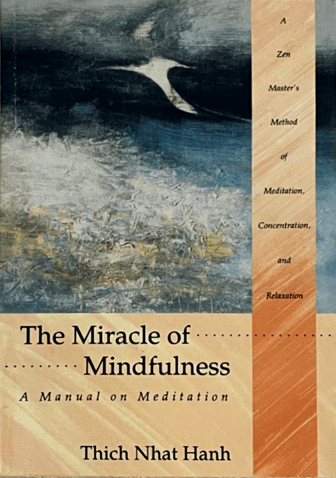
The Miracle of Mindfulness
By Thich Nhat Hanh
Excerpt
Excerpt
“Mindfulness is the miracle by which we master and restore ourselves. Consider, for example: a magician who cuts his body into many parts and places each part in a different region—hands in the south, arms in the east, legs in the north, and then by some miraculous power lets forth a cry which reassembles whole every part of his body. Mindfulness is like that—it is the miracle which can call back in a flash our dispersed mind and restore it to wholeness so that we can live each minute of life … Mindfulness enables us to live. You should know how to breathe to maintain mindfulness, as breathing is a natural and extremely effective tool which can prevent dispersion. Breath is the bridge which connects life to consciousness, which unites your body to your thoughts. Whenever your mind becomes scattered, use your breath as the means to take hold of your mind again.”
Essence
Essence
Mindfulness is the art of being fully alive – awake to your breath, your actions, and your everyday experience as the miracles that they already are.
In The Miracle of Mindfulness, Thich Nhat Hanh teaches that awakening is not achieved by escaping ordinary life but by fully inhabiting it; through conscious breathing, attentive movement, and gentle awareness, the most mundane activities become sites of presence, compassion, and freedom. For Nhat Hanh – Zen Master, poet, and peace activist – mindfulness is both a simple practice and a moral vision. By returning to the present moment with kindness, we reconcile body and mind, gather our fractured attention, and learn to meet ourselves, others, and the world with clarity and love. Written from exile as a letter to a friend in wartime Vietnam, Nhat Hanh’s heartfelt guide is as accessible as it is wise. From "the monk who taught the world mindfulness", this work is a natural place to begin with his teaching.
Embodiment: Living the Wisdom
Embodiment: Living the Wisdom
For Thich Nhat Hanh, there is no separation between spiritual practice and daily life. Mindfulness can be cultivated in the simple act of breathing, walking, cooking, or washing dishes: “Drink your tea slowly and reverently, as if it is the axis on which the whole earth revolves—slowly, evenly, without rushing toward the future. Live the actual moment. Only this actual moment is life.” The miracle Nhat Hanh points to is not mystical spectacle but the rediscovery of the forgotten gem of unpolished, ordinary existence.
As such, the path to enlightenment is not to transcend daily life but to descend further into it. It is the ordinary lived with extraordinary attention: “Meditation is not evasion; it is a serene encounter with reality. The person who practices mindfulness should be no less awake than the driver of a car; if the practitioner isn’t awake he will be possessed by dispersion and forgetfulness, just as the drowsy driver is likely to cause a grave accident. Be as awake as a person walking on high stilts—any misstep could cause the walker to fall … Be like a lion, going forward with slow, gentle, and firm steps. Only with this kind of vigilance can you realise total awakening.”
The book’s many practices retrain perception on the present. “Each act,” Nhat Hanh says, “is a rite, a ceremony.” Breath is particularly key, not simply as one exercise among others but as that which grounds all other practices and life itself. By gently returning to one’s breath – sometimes counting, sometimes simply following it, and best accompanied by a half-smile – mindfulness is restored and allowed to flow outward into the rest of the day.
Yet beneath these simple practices lies a deeper vision: that the self we cling to is not fixed or separate but woven into everything. Nhat Hanh often speaks of ‘interbeing’ – the insight that we do not exist on our own, but only in relationship with breath, with others, and with the world. To follow the breath, then, is not merely to calm the mind but to return to this deeper unity, where the boundary between self and world softens. Like a wave recognising it is water, the practitioner begins to live less from grasping and more from participation in the whole. Meditation, in this sense, is not an escape from life but a way of seeing that we have never been separate from it.
For those wishing to go deeper into their practice, either in person or online, the Plum Village community was founded by Nhat Hanh and offers retreats, teachings on engaged Buddhism, and many supportive resources.

“People usually consider walking on water or in thin air a miracle. But I think the real miracle is … to walk on earth. Every day we are engaged in a miracle which we don’t even recognize: a blue sky, white clouds, green leaves, the black, curious eyes of a child—our own two eyes. All is a miracle.”