Title details
Original Publication Date:1998
Edition Reviewed:Riverhead Books, 2009
Print Length:352 pages
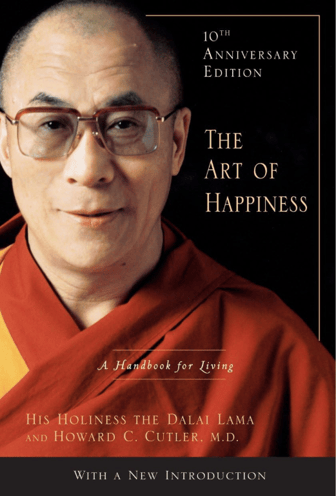
The Art of Happiness
A Handbook For Living
By His Holiness the Dalai Lama and Dr. Howard C. Cutler
Excerpt
Excerpt
“Success may result in a temporary feeling of elation, or tragedy may send us into a period of depression, but sooner or later our overall level of happiness tends to migrate back to a certain baseline. Psychologists call this process adaptation, and we can see how this principle operates in our everyday life; a pay raise, a new car, or recognition from our peers may lift our mood for a while, but we soon return to our customary level of happiness. In the same way, an argument with a friend, a car in the repair shop, or a minor injury may put us in a foul mood, but within a matter of days our spirits rebound. This tendency isn’t limited to trivial, everyday events but persists even under more extreme conditions of triumph or disaster. Researchers surveying Illinois state lottery winners and British pool winners, for instance, found that the initial high eventually wore off and the winners returned to their usual range of moment-to-moment happiness. And other studies have demonstrated that even those who are struck by catastrophic events such as cancer, blindness, or paralysis typically recover their normal or near-normal level of day-to-day happiness after an appropriate adjustment period. So, if we tend to return to our characteristic baseline level of happiness no matter what our external conditions are, what determines this baseline? And, more important, can it be modified, set at a higher level?”
Essence
Essence
True happiness is cultivated, not found; when you train your mind in kindness and clarity, joy arises naturally like water from a spring.
In The Art of Happiness, the personable and practical wisdom of His Holiness the Dalai Lama is explored and interpreted through conversation with his co-writer, the psychiatrist Howard C. Cutler. External suffering, in their exchange, serves as the constant reminder that joy should come from within, not from outer things or fleeting circumstances. "We don't need more money," the Dalai Lama counsels, "we don't need greater success or fame, we don't need the perfect body or even the perfect mate—right now, at this very moment, we have a mind, which is all the basic equipment we need to achieve complete happiness." Their discussions continually circle around a single, luminous point: "Happiness is determined more by one's state of mind than by external events" – and it is this shift, along with a way of practising it daily, that the book invites you into.
Embodiment: Living the Wisdom
Embodiment: Living the Wisdom
Reading The Art of Happiness feels like sitting across from the Dalai Lama as he chuckles, leans in, and quietly insists that joy isn’t out there somewhere – it’s already within you. Suffering occurs when we become too reliant on external things for our happiness, and so is a constant reminder to let go and turn within. Suffering is also the key to having empathy and compassion for others, for it is a universal experience that bridges us and even our worst enemies: “Let us meditate on compassion today. Begin by visualising a person who is acutely suffering.”
The concept of "achieving true happiness has, in the West, always seemed ill defined, elusive, ungraspable. Even the word 'happy' is derived from the Icelandic word happ, meaning luck or chance." Yet the Dalai Lama insists that our natural state is bliss (our "Buddha nature") and that this nature can be returned to through disciplining the mind rather than through luck and happenstance: the "more reliable method is not to have what we want but rather to want and appreciate what we have."
This begins with something as simple as starting each day with intention and ending it with honest review – rejoicing where we have acted well, resolving to improve where we have not. Aim to perform five acts of kindness at least one day a week, while also mentally preparing yourself for any anticipated suffering, just as an army prepares for battle by running drills ahead of time. Repeatedly filter your decisions through a single, practical question: "Will it bring me happiness?" Apply this not only to life-changing choices but to ordinary moments of desire, even in a supermarket aisle, where wanting is paused and need is questioned. What emerges is cumulative and ethical: small, repeated actions – practised again and again – that quietly form a life marked by restraint, care, and genuine wellbeing.
Ultimately, the Dalai Lama invites you to notice that you already possess the source of true happiness. Whatever clouds pass overhead — grief, disappointment, the ordinary friction of a day — the light beneath them is never extinguished, only obscured. The work, then, is not acquisition of something more, but an uncovering of what is always present.

“The true antidote of greed is contentment.”