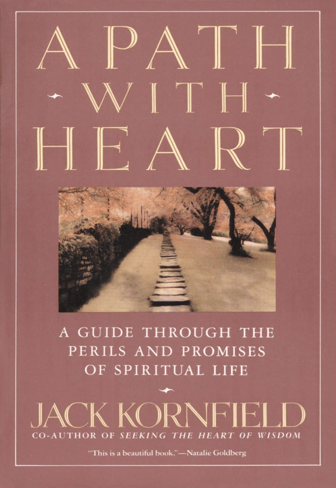
Title details
Original Publication Date:1993
Edition Reviewed:Bantam Books, 1993
Print Length:384 pages
A Path with Heart
A Guide Through the Perils and Promises of Spiritual Life
By Jack Kornfield
Excerpt
Excerpt
“In undertaking a spiritual life, what matters is simple: We must make certain that our path is connected with our heart. Many other visions are offered to us in the modern spiritual marketplace. Great spiritual traditions offer stories of enlightenment, bliss, knowledge, divine ecstasy, and the highest possibilities of the human spirit. Out of the broad range of teachings available to us in the West, often we are first attracted to these glamorous and most extraordinary aspects. While the promise of attaining such states can come true, and while these states do represent the teachings, in one sense, they are also one of the advertising techniques of the spiritual trade. They are not the goal of spiritual life. In the end, spiritual life is not a process of seeking or gaining some extraordinary condition or special powers. In fact, such seeking can take us away from ourselves. If we are not careful, we can easily find the great failures of our modern society—its ambition, materialism, and individual isolation—repeated in our spiritual life. In beginning a genuine spiritual journey, we have to stay much closer to home, to focus directly on what is right here in front of us, to make sure that our path is connected with our deepest love.”
Essence
Essence
An open heart is the hallmark of a worthy path.
Picture a young monk, fresh from spending five years in a Buddhist forest monastery, sitting cross-legged and meditating in the waiting lounge of a New York City spa, eyes closed, while a group of women in salon robes stare and ask, “Is he for real?” In 1972, that was Jack Kornfield's experience not long after returning from Asia to his home in the United States. In this clear and intimate exploration of the “perils and promises” of spiritual life, A Path with Heart recounts what Kornfield has learned in his own journey as a seeker and a teacher, drawing from the wisdom of many, and relating it to the everyday circumstances of the modern world. Importantly, Kornfield reveals that it was his post-monastic life that demanded a deepening of his practice – a shift downward, as he puts it, through the chakras, from mind to heart to body, and it is from this grounded, whole sense of himself that he offers guidance, always with good humour, gentleness, and clarity. Across four parts, the book moves from the fundamentals of practice – concentration, healing, daily discipline – into the perils and promises that follow: altered states, dark nights, and the energetic openings serious practice can bring. It then widens outward into karma, forgiveness, and the place of teachers and community, before closing on what Kornfield calls spiritual maturity – an undivided heart, wise enough to hold both the sacred and the ordinary as one. Replete with meditations, A Path with Heart skilfully weaves together Eastern Buddhist philosophy and practice with Western psychology, resulting in an accessible modern guidebook to loving and living well.
Embodiment: Living the Wisdom
Embodiment: Living the Wisdom
A Path with Heart draws from Jack Kornfield’s lived experience of spiritual unfolding, teaching, and integrating: “the greatest lesson I have learned is that the universal must be wedded to the personal to be fulfilled in our spiritual life.” So instead of teaching from an exalted status, the book offers candid, personal reflections from his own life, his students, and his teachers. He explains that the title takes inspiration from Carlos Castaneda's Don Juan: “Does this path have a heart? If it does, the path is good. If it doesn't, it is of no use.”
Kornfield is forthcoming from the beginning about how his own spiritual path did not progress smoothly. Within weeks of returning from five years in Buddhist monasteries in Asia, he disrobed, enrolled in graduate school, and took a job driving a taxi. What he came to realise is that his years of meditation in the monasteries had thoroughly trained his mind, but left his heart largely untouched. It was when he returned to everyday life and relationships that he understood his practice needed to deepen downward and include his heart and body: “As my practice has proceeded down the chakras, it has become more intimate and more personal… The way I treat my body is not disconnected from the way I treat my family or the commitment I have to peace on our earth.”
One of the clearest teachings, and practices, in the book is something Kornfield explains as taking the one seat. His own teacher, a Thai monk named Achaan Chah, described it this way: put a single chair in the middle of an empty room, open the doors and windows, and simply watch who comes to visit: “Your only job is to stay in your seat. You will see it all arise and pass, and out of this, wisdom and understanding will come.” By way of example, Kornfield cites the experience of a man at one of his retreats who lost his 4-year-old daughter in a car accident, while he was driving. Since her death, the man had turned to his spiritual practice, surrounding his meditation cushion with crystals and photographs of teachers – all of which Kornfield observed kept his grief at a distance. Asking him to set everything aside and sit alone in the seat, the release was immediate: “in five minutes he was crying. In ten minutes he was sobbing and wailing. He had finally let himself take the seat in the midst of his sorrow; he had finally, truly begun to grieve.”
Kornfield also shares a teaching about the Buddha known as the lion's roar – a powerful symbol for the courage that staying power can require. On the night the Buddha reached enlightenment, he was first attacked by Mara, a figure in Buddhist tradition who represents every form of fear, temptation, and self-doubt. Rather than move from his seat, the Buddha defiantly held his ground until Mara's assault passed. It stands as a model and inspiration for all who encounter challenges on their respective paths: “We each need to make our lion's roar—to persevere with unshakable courage when faced with all manner of doubts and sorrows and fears—to declare our right to awaken.”
Addressing the reader’s search for their own path, Kornfield offers guidance to neither go it alone nor surrender your own judgment, but to stay connected to “your deepest love” and to stay long enough for real transformation. Jumping between practices, he warns, is “like [digging] many shallow wells instead of one deep one.”
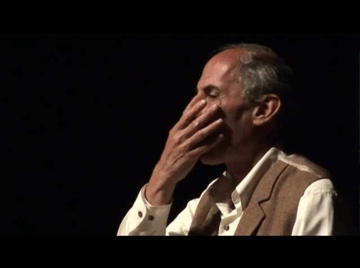
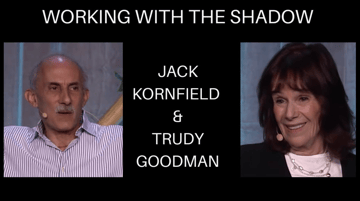
A Path with Heart is itself born of Kornfield’s deep, open-hearted engagement with the Buddhist path, seamlessly integrated with his background in clinical and transpersonal psychology. Widely considered a classic guide to meditation and integration, it is a popular gateway to a further wealth of resources from Kornfield, who continues to teach at the Insight Meditation Society in Massachusetts and the Spirit Rock Meditation Center in California. Readers who wish to go deeper into his work can find his talks, courses, and guided meditations in the links below.

“I was forced to shift my whole practice down the chakras from the mind to the heart. I began a long and difficult process of reclaiming my emotions, of bringing awareness and understanding to my patterns of relationship, of learning how to feel my feelings, and what to do with the powerful forces of human connection. I did this through group and individual therapy, through heart-centered meditations, through transpersonal psychology, and through a series of both successful and disastrous relationships.”