Title details
Original Publication Date:2021
Edition Reviewed:Penguin Random House, 2021
Print Length:288 pages
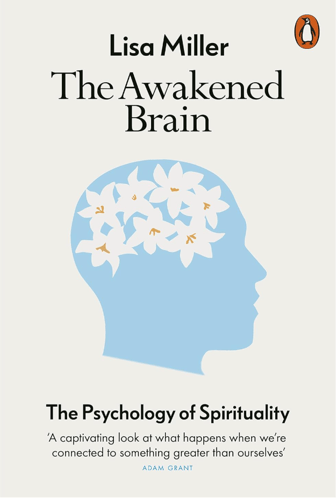
The Awakened Brain
The Psychology of Spirituality
By Lisa Miller
Excerpt
Excerpt
“I’m a scientist. Not a theologian. Faith traditions have a lot to say about ontological questions—the nature of reality, why we’re here, the existence and guidance of God or a higher power. As a scientist, I don’t address these issues. I look at how humans are built and how we are built over the life span.
I’ve discovered that the awakened brain is both inherent to our physiology and invaluable to our health and functioning. […]
An awakened brain is available to all of us, right here in our neural circuitry. But we have to choose to engage it. It’s a muscle we can learn to strengthen, or let atrophy. I’ve come to see the problems we have in leadership, education, social justice, the environment, and mental health as different emanations of the same problem: unawakened awareness. A universal, healing capacity that has not been engaged or cultivated, that’s been left to die on the vine. The problem is within. And so is the solution.
Each one of us has the ability to fully develop our innate capacity to live through an awareness of love, interconnection, and appreciation of life’s unfolding. Beyond belief, beyond a cognitive story we tell ourselves, the awakened brain is the inner lens through which we access the truest and most expansive reality: that all of life is sacred, that we never walk alone. Our brains are wired to perceive and receive that which uplifts, illuminates, and heals.”
Essence
Essence
Neuroscience reveals your greatest antidote to depression and anxiety isn't a pill – it is awakening your innate spiritual capacity.
The Awakened Brain draws from over two decades of clinical research to demonstrate that spiritual awareness is an innate, measurable neural capacity that, when activated, has profoundly beneficial effects on mental health. Lisa Miller, PhD, professor of clinical psychology at Columbia University, and founder of its Spirituality Mind Body Institute, researches what happens in the brain when someone lives with a felt sense of connection to something greater than the self. Her work is rigorous and ground-breaking: sustained spiritual engagement correlates with measurably thicker regions of the cortex, with lower rates of depression, anxiety, and addiction, and, in a ten-year study of families at high risk for depression, with roughly a five-fold protective benefit passed from parent to child. Woven throughout Miller’s presentation of the hard science of spirituality is her own journey, one in which she awakens from what she calls the “achieving brain.” Miller’s personal transformation from infertility and depression to an open, awakened state, brings to life what all the book’s research points to: spiritual awareness is not a belief system but a capacity that can be cultivated by anyone to live with demonstrably greater health, resilience, and fulfilment.
Embodiment: Living the Wisdom
Embodiment: Living the Wisdom
In The Awakened Brain, Lisa Miller distinguishes two states that our brains move between: what she calls “Achieving Awareness,” the mode of control, advancement, and outward goals, and “Awakened Awareness,” the mode of perception, connection, and openness to a larger field of meaning. She writes candidly of years that she and her husband spent in the first mode without knowing it: “I didn't yet have the science to explain it, but we were beginning to suffer from choices made through what I would later understand to be our achieving brains, chasing down sensible goals—of advancement, protection—that would not fulfill us, that would cultivate stress and fear and disconnection, because outward goals are no substitute for larger meaning and purpose. We were living half-awake.”
Miller's personal journey through infertility runs alongside the clinical research throughout the book – a long season of grief and depression that eventually gave way, through an increased perception of synchronicity and a felt connection to something larger, to becoming a mother. Central to her message is that spirituality is not reserved for a few, and need not be defined by a tradition or belief. She points to how virtually everyone has had some experience that could be defined as ‘spiritual’: “Many of us have had experiences we might describe as spiritual. A moment of deep connection with another being or in nature. A feeling of awe or transcendence. An experience of startling synchronicity [...] A time you felt held or inspired or buoyed up by something greater than yourself—a higher power perhaps, but also nature or the universe or even the surge of connection at a concert or sporting event.” From this vantage point, spirituality is universally accessible and something you have likely already experienced; the invitation is to simply cultivate more of it in your life.
One of the most distinctive conclusions from Miller’s years of peer-reviewed clinical research is the relationship between depression and spirituality: “Depression and spirituality appeared to be two sides of the same coin, vastly different experiences that in fact share some significant physiology. I had long wondered from an epidemiological and clinical perspective if some types of depression might be a symptom of a person’s craving for spirituality and a call for the spiritual self to awaken. Now we could see in a physiological, material way that spirituality is a consciousness for which all of our brains are wired, and that, long-term, the spiritually engaged brain is a healthier brain. Suddenly depression didn’t look like an illness, at least not all the time. It looked like a sensitivity or perceptual capacity—a knock at the door for the opportunity of an awakened brain.”
What emerges from Miller's research, and from her own path through it, is something practical and applicable to every modern life: awakened awareness isn't reserved for the mystically inclined, but a capacity built into ordinary neurology, available to be strengthened by anyone. You could begin by expanding your field of attention – to synchronicity, to connection, to the moments that already feel larger than yourself. Miller also shares practices, such as visualisation exercises, for expanding spiritual awareness and awakening connection. Readers who want to go deeper into Miller's ongoing work can find more resources at Columbia's Spirituality Mind Body Institute.

“We all have the neural wiring for awakened awareness. What do recessive and dominant genes suggest? Only that just as some people see color more vividly, with more rods and cones in their eyes, so some people see the hues of awakened awareness more readily. Let this not be another realm for ranking or comparing ourselves to others. We all have what we need for awakened awareness, a doorway into a broad range of personal journeys and adventures, a common portal to a more unified and loving world.”