Excerpt
Excerpt
“Slowly, taking many detours, I have changed from a man into a child, a thinker into a child-person. And yet this winding path has been a good one, and the bird in my breast has not died. But what a path it was! I have had to pass through so much ignorance, so many burdens, so much error, so much disgust and disappointment and sorrow, just to become a child and start from the beginning again. But it was right! My heart says yes to it, my eyes laugh at it. I have had to feel despair, to sink down to the most foolish thought of all, the thought of suicide, so that I could experience grace, and hear the OM again, and truly sleep and truly awaken. I had to become a fool to find Atman in me again. I had to sin to be able to live again. Where else might my path take me? Foolish is this path; it runs in loops, perhaps even in a circle. Let it go where it will – I will walk it.”
Essence
Essence
Life is the most perfect teacher you could ever seek.
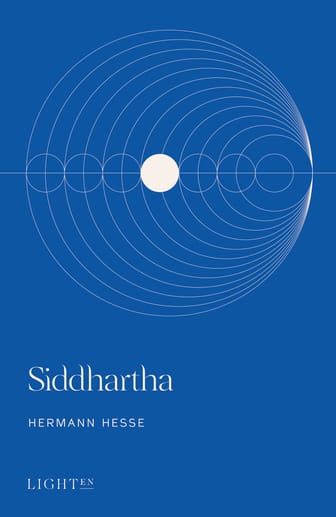
Hermann Hesse’s Siddhartha is a short, lyrical novel set in an imagined India of the fifth century BCE. Its protagonist – Siddhartha, a gifted young brahmin (not the historical Buddha) – is restless from the very first pages. Beloved by all, admired for his learning and beauty, he carries a quiet ache: the knowledge he has received does not reach the place where the real thirst lives. And so he sets out on a journey, encountering ascetics, enlightened teachers, the world of pleasure and commerce, and the unhurried wisdom of a river. With its easy, flowing quality, the experience of reading Siddhartha is transporting. It leaves you, by the end, with a greater appreciation for life and wisdom that can be hard to put into words, though if you tried, it might simply sound like OM.
Embodiment: Living the Wisdom
Embodiment: Living the Wisdom
The book opens with a portrait of spiritual discontent. Siddhartha seemingly has everything – devotion, intelligence, the love of everyone around him – and yet, he “carried no joy in his own heart. Dreams and restless thoughts came to him, flowing from the river water, glittering from the stars at night.” There is something in him that the received wisdom of his tradition cannot touch. This is Hesse’s opening provocation: the very thoroughness of a spiritual education can become an obstacle to the direct encounter it promises.
The question Siddhartha eventually arrives at is arresting: what if the self he has been trying to dissolve, transcend, or see through is not the problem but the starting point? Leaving behind his last teacher, he realises: “No more will I learn from Yoga-Veda, or Atharva-Veda, or the ascetics, or any doctrine. I will learn from myself, become my own pupil and learn to know myself, to find the secret of Siddhartha.” This is not a declaration of arrogance but of a particular kind of trust – the willingness to treat one’s own life as a text worth reading.
The world, once this shift has occurred, is suddenly alive. “Meaning and essence were not somewhere behind things, but in them, in everything.” This is the shift the novel is really about: not from ignorance to enlightenment, but from abstraction to presence – from seeking meaning beyond life to finding it inside it.
At the heart of the book is a river, and the quiet teaching it carries. The river is everywhere at once, always changing and always itself, and it speaks – for those who learn to listen – in a single word. Hesse uses it to embody what the mind cannot grasp through argument: that all the contradictions of a life – the noble and the degraded, the awakened and the lost, the past and the future – are simultaneous and whole. “Nothing was and nothing will be; everything is; everything has being and presence.”
The book also offers a subtle teaching on seeking itself. “When a person searches, it is easy for their eyes to see only the thing they are searching for. They cannot find anything, allow anything in, because their mind is always on what they are seeking; they have a goal, and that goal is their obsession. Seeking means having a goal. But finding means being free and open, having no goal.” This is not a counsel of passivity. It is an invitation to a different quality of attention: the kind that can receive what is already here.
For Siddhartha, it is by virtue of the journey itself – through all its wandering, its losses, its hard-won stillness – that love reveals itself as the keynote. Not romantic love, nor doctrinal compassion, but something more like a complete openness to the world as it is. “All I want is to love the world, not to disdain it, not to hate both it and myself, but to regard it and myself and all life with love and admiration and reverence.”

“Seeking means having a goal. But finding means being free and open, having no goal. You, venerable one, may really be a seeker, for in pursuit of your goal, you overlook many things that are right before your eyes.”