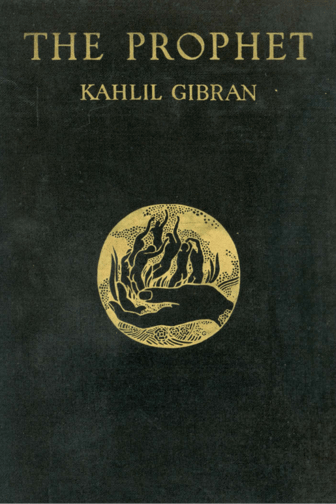
Title details
Original Publication Date:1923
Edition Reviewed:Alfred A. Knopf, 1923
Print Length:107 pages
The Prophet
By Kahlil Gibran
Experience the Book
Excerpt
Excerpt
“You work that you may keep pace with the earth and the soul of the earth.
For to be idle is to become a stranger unto the seasons, and to step out of life’s procession, that marches in majesty and proud submission towards the infinite.
When you work you are a flute through whose heart the whispering of the hours turns to music.
Which of you would be a reed, dumb and silent, when all else sings together in unison?
Always you have been told that work is a curse and labour a misfortune.
But I say to you that when you work you fulfil a part of earth’s furthest dream, assigned to you when that dream was born,
And in keeping yourself with labour you are in truth loving life,
And to love life through labour is to be intimate with life’s inmost secret.
But if you in your pain call birth an affliction and the support of the flesh a curse written upon your brow, then I answer that naught but the sweat of your brow shall wash away that which is written.
You have been told also that life is darkness, and in your weariness you echo what was said by the weary.
And I say that life is indeed darkness save when there is urge,
And all urge is blind save when there is knowledge,
And all knowledge is vain save when there is work,
And all work is empty save when there is love;
And when you work with love you bind yourself to yourself, and to one another, and to God. […]
Work is love made visible.”
Essence
Essence
You do not possess your life; you are the shape love takes as it moves through you.
Kahlil Gibran’s The Prophet gathers twenty-six discourses delivered by Almustafa, described as the chosen and the beloved, in the hours before he departs the city of Orphalese after twelve years among its people. The townsfolk ask him to speak on nearly every dimension of an ordinary life: love and marriage, work and pain, and freedom and death among them, and Almustafa answers not as a lawgiver handing down doctrine but as a mirror, disclosing to the people what already moves within them. Written in cadenced free verse and first published in 1923, the book draws without conflict on Christian, Islamic, and Eastern currents of thought, addressing the reader directly and universally rather than through any single tradition. Each discourse stands complete on its own, yet together they trace the arc of a life, holding birth, love, labour, sorrow, and death as a single continuous unity. If you are seeking a companion for the questions that return at every stage of living, Gibran’s slender masterpiece offers an invitation to recognise the wisdom already dawning in your own heart.
Embodiment: Living the Wisdom
Embodiment: Living the Wisdom
Kahlil Gibran structured The Prophet as twenty-six discourses framed by a single day: the long-awaited arrival of Almustafa’s ship, and his final walk through the city before he sails. The frame itself teaches something. A wanderer who has lived among the people for twelve years is asked to speak only as he is leaving, as though truth is heard most clearly by those about to lose the one who speaks it.
Asked first of Love, Almustafa answers that it is a blessing inseparable from its demand: “For even as love crowns you so shall he crucify you. Even as he is for your growth so is he for your pruning.” Love here is not comfort but transformation; it does not spare what must be threshed, sifted, or ground. The same refusal to soften the truth returns when he is asked of Marriage. He counsels not merger but a distance held in trust: “Let there be spaces in your togetherness… For the pillars of the temple stand apart, and the oak tree and the cypress grow not in each other’s shadow.” Asked next of Children, he answers a mother holding her baby with some of the book’s most quoted lines: “Your children are not your children. They are the sons and daughters of Life’s longing for itself. They come through you but not from you, and though they are with you yet they belong not to you… You are the bows from which your children as living arrows are sent forth.” Each of these early discourses works the same way: dismantling the reader’s instinct to possess and hold, so that what remains is connection without grasping.
Asked of Work by a ploughman, Almustafa gives what has become his most quoted line: “Work is love made visible.” Idleness is treated not as sin but as exile: “to be idle is to become a stranger unto the seasons.” Work undertaken with love becomes indistinguishable from devotion, while work performed with resentment poisons what it produces.
The discourses on Pain, Self-Knowledge, and Reason and Passion turn the same gaze inward. Pain is “the breaking of the shell that encloses your understanding,” not punishment but the necessary rupture of growth. On Self-Knowledge, Almustafa refuses false certainty: “Say not, ‘I have found the truth,’ but rather, ‘I have found a truth.’” And where reason and passion might seem opposed, he asks that both be honoured equally, so that the heart may say in turn, “God rests in reason” and “God moves in passion.”
The Prophet is a much loved spiritual classic that is as memorable as it is brief. The encounter closes as it began: with departure. Asked of Death, Almustafa draws attention to the same unity he has taught throughout: “For life and death are one, even as the river and the sea are one.” In the Farewell that follows, his leave-taking becomes a promise of return, reframing the whole book not as a final teaching but as one turn of a truth that circles back, ever ready to be met again.

“When love beckons to you, follow him, Though his ways are hard and steep… For even as love crowns you so shall he crucify you. Even as he is for your growth so is he for your pruning.”