Title details
Original Publication Date:Light on the Path, 1885 / ‘Karma,’ 1888
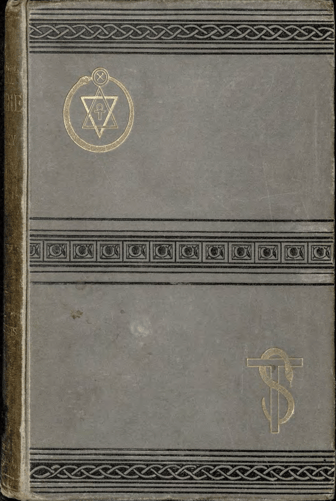
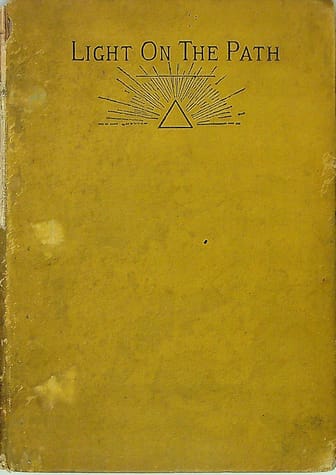
Edition Reviewed:Private Press, 1893. No. 10 of 12 copies. Held in the Theosophical Society Library of England & Wales (content) / Cupples, Upham and Co., 1886 (cover)
Print Length:47 pages
Light on the Path
By Mabel Collins – scribe
Experience the Book
Excerpt
Excerpt
“Seek it not by any one road. To each temperament, there is one road which seems the most desirable. But the way is not found by devotion alone, by religious contemplation alone, by ardent progress, by self-sacrificing labour, by studious observation of life. None alone can take the disciple more than one step onwards. All steps are necessary to make up the ladder. The vices of men become steps in the ladder, one by one, as they are surmounted. The virtues of man are steps indeed, necessary—not by any means to be dispensed with. Yet, though they create a fair atmosphere and a happy future, they are useless if they stand alone. The whole nature of man must be used wisely by the one who desires to enter the way. Each man is to himself absolutely the way, the truth and the life.
But he is only so when he grasps his whole individuality firmly, and by the force of his awakened spiritual will recognises this individuality as not himself, but that thing which he has with pain created for his own use, and by means of which he purposes, as his growth slowly develops his intelligence, to reach to the life beyond individuality. When he knows that for this his wonderful complex separated life exists, then, indeed, and then only, he is upon the way. Seek it by plunging into the mysterious and glorious depths of your own inmost being.”
Essence
Essence
When you are ready, nothing in you is an obstacle to the way of discipleship; everything in you, rightly used, is a step upon it.
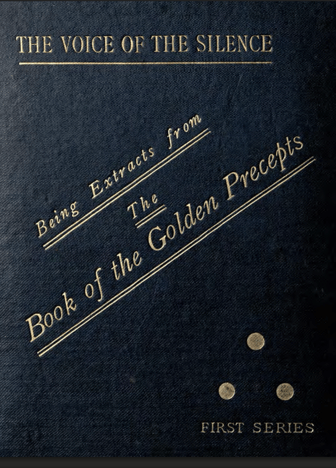
Light on the Path is considered by the Theosophical Society to be among the oldest texts in the theosophical canon – originating as a palm-leaf manuscript in archaic Sanskrit, transmitted through a lineage of Masters, and written down for the first time in English by Mabel Collins (M.C.) in 1885. Consisting of 42 rules across two parts – each with accompanying notes and commentary – it brings the distilled wisdom of the East to Western seekers in the form of a precise and brief manual: directions laid down for those who stand ready to enter the path of discipleship. Paired here with the companion essay ‘Karma,’ it belongs to the same tradition as Helena Blavatsky’s The Voice of the Silence – both offering instruction from those who have trodden the path of discipleship to those who desire to tread it, each speaking to a different stage of the journey. Light on the Path addresses the aspirant at the threshold; its precepts have several layers of meaning and can be returned to again and again as the journey deepens. As stewards of the Theosophical Society Library of England & Wales, LightEn is making available a unique copy from the Rare Collection: a private press edition of 1893 – one of only twelve copies printed – which appears to be the only exemplar catalogued in an institutional collection.
Embodiment: Living the Wisdom
Embodiment: Living the Wisdom
Light on the Path is direct and unsparing from the outset. In the first part of the work, the 21 rules appear, at first, to be renunciations – kill ambition, desire, comfort, the hunger for growth, etc. But the text immediately reverses itself: work as those work who are ambitious, live as those do who desire it. The instructions are not a negation of these forces but a purification of their motive. What is being asked is not asceticism but transformation: to act without the personal self at the centre, to serve the work rather than the worker. The subtler forms are the more dangerous ones. The same impulse, for example, that drives worldly ambition reappears in the disciple who has enlarged their limits of experience but not yet released the self at the centre of it.
This path is not going to be easy. Rule 5 – “Kill out all sense of separateness” – is among the most demanding in all spiritual literature. Its note makes the stakes precise: “the sin and shame of the world are your sin and shame; for you are a part of it, your Karma is inextricably interwoven with the great Karma.” To allow the idea of separateness to grow – even toward what repels you – is to create Karma that binds you to it. The soiled garment you shrink from may have been yours yesterday, or perhaps still will be in the future. The rule therefore demands not just recognition but active response: “do not condemn the man that yields: stretch out your hand to him as a brother pilgrim whose feet have become heavy with mire.”
Rules 8 through 21 turn to what lies beneath: the light within, the song of life, the Warrior, and the bloom in the silence. Rule 20 – quoted in the excerpt above – is the pivot. The way is not found by any single road because the whole nature must be engaged. The vices are not obstacles discarded before the path begins; they are steps, surmounted one by one. And the life that feels most impossibly complex is precisely the instrument through which the life beyond individuality is reached.
The great promise of the book arrives in Rule 21, which describes the silence that follows the storm – a moment that cannot be hastened to arrive: “Call it by what name you will, it is a voice that speaks where there is none to speak—it is a messenger that comes, a messenger without form or substance; or it is the flower of the soul that has opened. It cannot be described by any metaphor. But it can be felt after, looked for, and desired, even amid the raging of the storm.” This is not the silence of peace achieved once and kept. The battle must be fought and won again and again. “It is only for an interval that nature can be still.” The fruit of this work is not arriving at a permanent state but learning to recognise, and return to, the still point at the heart of every storm – and, in Part II, to hear within that stillness the Warrior who is “thyself, yet infinitely wiser and stronger than thyself.”
The companion essay ‘Karma’ supplies the underlying mechanics that make these rules not merely ethical counsel but a precise response to the laws of cause and continuity. Individual existence, Collins writes, is a rope stretching from the infinite to the infinite – its threads living, like quivering nerves, easily snagged, stained, or pulled awry. Every act of separateness, every moment of self-righteous recoil, disorders the threads and binds you further. There is no escaping karma in the plane in which it operates; the only cure is to fix sight and hearing upon that which is invisible and soundless: “Live in the eternal.”
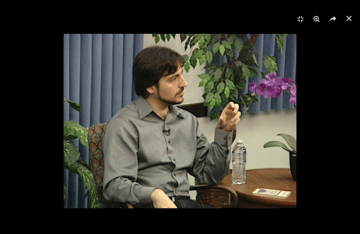
A short treatise, this theosophical classic has spawned numerous editions, articles, and talks as communities and individuals have sought to better understand the full meaning and application of its wisdom on the path of discipleship. Pablo Sender, a leading theosophical scholar, offers a modern interpretation in his four-part series (link below), for those who want to go deeper.

“Each man is to himself absolutely the way, the truth and the life. But he is only so when he grasps his whole individuality firmly, and by the force of his awakened spiritual will recognises this individuality as not himself, but that thing which he has with pain created for his own use.”