Title details
Original Publication Date:1949
Edition Reviewed:Theosophical Publishing House, Adyar, 1976
Print Length:304 pages
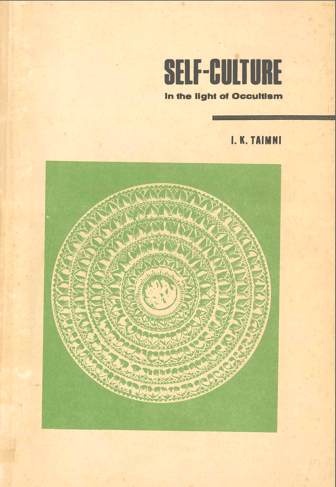
Self-Culture
In the Light of Occultism
By I. K. Taimni
Experience the Book
Excerpt
Excerpt
“The goal of Self-Culture … is living a life of perfect freedom in conscious at-one-ment with the divine Spirit and wielding with perfect mastery the powers and faculties belonging to all the planes in carrying out the divine Will. But this is a goal which an aspirant can reach only after several lives of intensive effort. Has then Self-Culture nothing to offer in the immediate present …? Decidedly not. Those who go through this book will see immediately that even a little progress made in this line will be of great advantage to the student and free him from most of the anxieties and miseries of life. Let the reader imagine, for a while, his life as it would be if he were able to acquire control over his physical body, emotions and thoughts and were able to regulate their activities in accordance with the dictates of his reason and higher judgement. Let him imagine himself without physical attachments, without emotional disturbances and the worries and anxieties of a disturbed and harassed mind, living a perfectly serene life amidst the circumstances in which his lot is cast, depending upon his inner resources for that strength and happiness which ordinary people seek, in vain, in the outer world. […]
So Self-Culture has a message of hope and encouragement and a happy life for every one and no one who makes a beginning in right earnest can fail to reap its benefits from the very start. Even when death comes he knows that he has laid the foundations of an enlightened and free life, has set his feet on the path which leads to his goal, and will take up in his next life this fascinating work at the point where he has dropped it in this one."
Essence
Essence
You can choose to awaken the divine qualities already within you; Self-Culture offers a scientific path.
Self-Culture in the Light of Occultism is Dr. I.K. Taimni's systematic case that human development is a science, not a hope. Scientist, scholar, and longtime leader in the Theosophical Society in India, Taimni advanced theosophical knowledge through a number of published works, including Self-Culture. For Taimni, man is not one body but a set of interpenetrating vehicles of consciousness – physical, astral, lower and higher mental, buddhic, atmic – each with specific functions, each governed by precise laws, each capable of refinement. Self-Culture, properly understood, is the methodical work of bringing each of these vehicles under the control of the Higher Self, clearing the channel through which the divine life can finally find expression. Taimni works through every level of the human constitution in turn, from the purification of diet and physical habit through the discipline of desire, the training of the mind in concentration and discrimination, the awakening of Buddhi – the faculty of spiritual intuition – and ultimately the practice of Samadhi, where consciousness escapes the mental body altogether and the student gains direct knowledge of his own immortal nature. The book's keynote is neither mystical longing nor moral instruction but something rarer: the confidence of an investigator who really knows the terrain. Taimni's message is, above all, encouraging: the laws governing inner development are as reliable as the laws governing the physical world, and your progress, if you work rightly, is assured.
Embodiment: Living the Wisdom
Embodiment: Living the Wisdom
Self-Culture in the Light of Occultism begins with a reorientation of identity: “The real problem of spiritual life is somehow to shift this focus of consciousness which is now situated in the personality into the Individuality and to live from that centre, using the personality as a mere instrument on the lower planes.” Until that shift is made – not just understood – you remain identified with the transitory, oblivious of the far larger life available to you.
The path Taimni lays out is vehicle by vehicle, beginning with the physical. Your body is an instrument, and like any instrument it requires understanding, care, and discipline before it becomes responsive. What you eat, how you rest, what habits you permit – these are not incidental to spiritual development. They determine the vibratory quality of the matter composing the body, and that quality either helps or hinders the influx of subtler energies from within. The principle holds at every level: purity means the presence of those constituents that harmonise with the Higher Self, and the absence of those that resist it.
The astral body – the vehicle of desire, feeling, and emotion – demands more subtle work. A desire forcibly suppressed passes into the subconscious and festers. What is required is dissociation: learning to observe your desires and emotions as movements in a vehicle, not expressions of what you are. From that position of witness, you can cease feeding the energies you wish to dissolve and redirect them.
Mental training follows the same logic. The lower mind, left to itself, wanders and sees everything through the colouring of its existing tendencies. “Just as a mirror covered with dirt cannot reflect the rays of the sun, so a mind which is impure is unable to mirror Truth.” The work is two-directional: concentration that deepens until the mind can hold a single idea without wavering, and the patient removal of biases and complexes that prevent clear seeing.
‘Buddhi’ is identified as the crux. Buddhi is not your intellect – intellect analyses what it already knows – but the faculty that directly recognises spiritual truth, perceiving the unity behind apparent division, and providing the unerring guidance intellect cannot supply. Its development cannot be forced; it unfolds as the lower vehicles are purified and the passage to the higher planes is opened. “It is necessary to realize that all knowledge exists eternally in the Consciousness of the Logos of our Solar System and as we develop our inner faculties we acquire the capacity to come into touch with it at different levels. We have, as it were, to tune ourselves in through our different vehicles, to different levels of His Consciousness in order to come into touch with everything at the respective levels.” Every stage of discipline is preparation for this tuning.
The culmination is ‘Samadhi.’ When concentration has deepened to the point where the mind can hold a single idea without wavering, and then release that idea entirely – keeping the mind still, concentrated, and empty – “consciousness escapes from the mental body and passes into planes beyond those of the lower mind. Then only does he gain direct knowledge of his real nature, knows that he is immortal and shares the divine life. He is now able to transcend, to some extent, the illusions of the lower life and to understand life as it really is. It is true that before him lie still greater vistas of achievement and enlightenment but he has gained a glimpse into the realities of life, and can never be the same man again.”
The multi-life perspective running throughout the work is not consolation for slow progress but liberation from the false urgency of a single lifetime. Nothing genuinely earned is lost – the Ego carries the distilled essence of each life forward. What Self-Culture promises is that even now, in this life, the work yields immediate fruit.

“The process is really the gradual and increasing release of a life of infinite possibilities, the progressive expansion of consciousness which will ultimately embrace everything in the universe. What have to be constructed and evolved at this stage are the lower vehicles through which the divine life within us finds expression, and not the life and its expression.”