Title details
Original Publication Date:1905
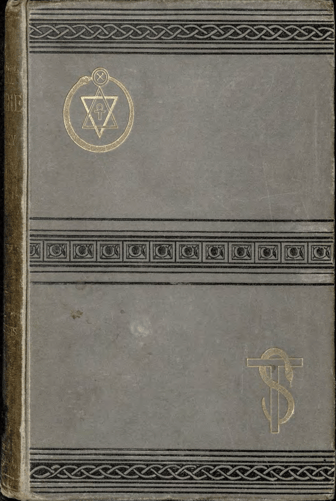
Edition Reviewed:Theosophical Publishing Society, 1905
Print Length:84 pages
Image Credit:p. iii, p. 64
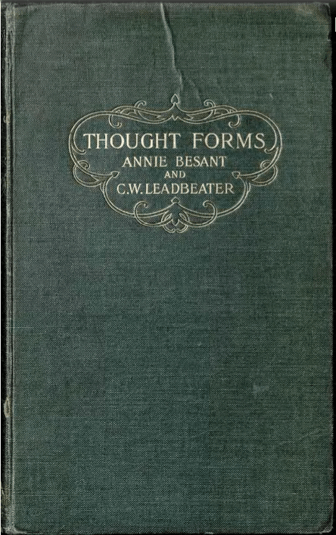
Thought-Forms
By Annie Besant and C.W. Leadbeater
Experience the Book
Excerpt
Excerpt
“Thought-forms directed towards individuals produce definitely marked effects, these effects being either partially reproduced in the aura of the recipient and so increasing the total result, or repelled from it. A thought of love and of desire to protect, directed strongly towards some beloved object, creates a form which goes to the person thought of, and remains in his aura as a shielding and protecting agent; it will seek all opportunities to serve, and all opportunities to defend, not by a conscious and deliberate action, but by a blind following out of the impulse impressed upon it, and it will strengthen friendly forces that impinge on the aura and weaken unfriendly ones. Thus may we create and maintain veritable guardian angels round those we love, and many a mother's prayer for a distant child thus circles round him, though she knows not the method by which her ‘prayer is answered.’”
Essence
Essence
Your thoughts and emotions shape what you experience and project; the study of thought-forms makes visible your power and responsibility.
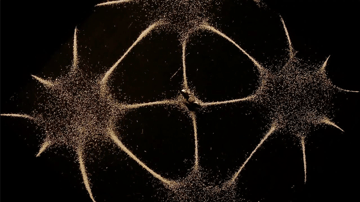
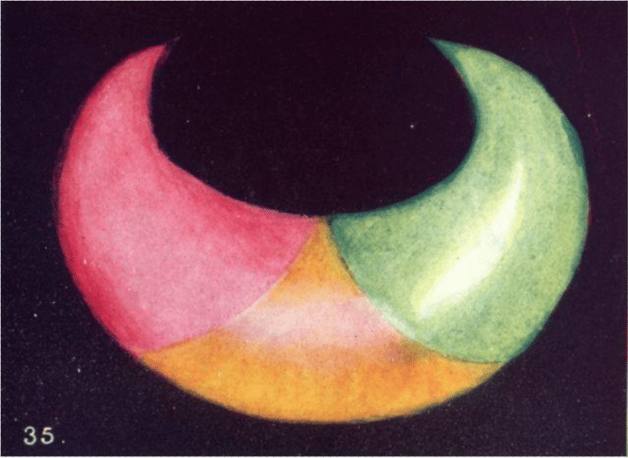
Leading figures of the Theosophical Society, Annie Besant and Charles Webster Leadbeater, recorded their observations in Thought-Forms, a systematic study of how thoughts and emotions manifest to those able to perceive them clairvoyantly. “We have often heard it said that thoughts are things, and there are many among us who are persuaded of the truth of this statement. Yet very few of us have any clear idea as to what kind of thing a thought is, and the object of this little book is to help us to conceive this.” Published in 1905, the authors frame their pioneering study within the scientific discourse of the day, giving the example of a Chladni sound plate to demonstrate how invisible frequencies give rise to visible order. At the end of the 19th century, discoveries such as Wilhelm Röntgen's X-rays, Marie Curie's research on radioactivity, and Margaret Watts Hughes' invention of the eidophone were revealing phenomena imperceptible to the ordinary senses. Besant and Leadbeater offered a parallel revelation: that our thoughts and emotions give rise to energetic forces that shape both ourselves and the world we collectively inhabit. In the first part of their treatise, they show how thoughts produce a vibration and a corresponding form, providing vivid, colourful illustrations drawn from their clairvoyant observations. The latter half documents a spectrum of thought-forms associated with emotional states, meditative experience, and music. Over the years, Thought-Forms has become increasingly recognised for its cultural influence, especially on the emergence of abstract art – Kandinsky, Hilma af Klint, Mondrian, and Klee all drew on the book's visual language of colour and form.
Embodiment: Living the Wisdom
Embodiment: Living the Wisdom
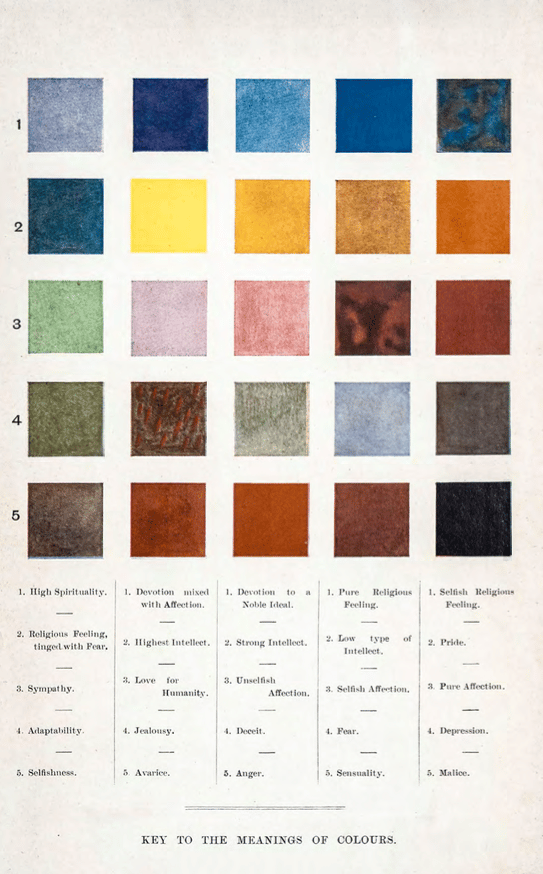
For Besant and Leadbeater, we all possess bodies beyond the physical, including a mental and an astral (emotional) body from which most of our thought-forms are generated. Each thought-form carries an emotional frequency that corresponds to a specific colour tone. For example, devotion appears as a rich cobalt blue, sympathy as light green, and philosophical thought as golden, which becomes a luminous lemon when an intellect is devoted to serving humanity. If our thoughts and emotions are directed towards another person, the resulting thought-forms can potentially affect their astral and mental bodies. Most personal thoughts, however, hover around their creator, quietly shaping their inner state.
Thought-Forms reveals how our perception of reality is filtered and obscured by our own habitual inner life: “Each man travels through space enclosed within a cage of his own building, surrounded by a mass of the forms created by his habitual thoughts. Through this medium he looks out upon the world, and naturally he sees everything tinged with its predominant colours, and all rates of vibration which reach him from without are more or less modified by its rate. Thus until the man learns complete control of thought and feeling, he sees nothing as it really is, since all his observations must be made through this medium, which distorts and colours everything like badly-made glass.”
When we apply this knowledge to daily life, we are reclaiming responsibility for thought as a creative force behind our reality and world; and we can learn to consciously direct this energy with intention: “See how great is the happiness this knowledge brings to us, and how gloriously we can utilise it when we know of some one in sorrow or in suffering. Often circumstances arise which prevent us from giving physical help either by word or deed, however much we may desire to do so; but there is no case in which help by thought may not be given, and no case in which it can fail to produce a definite result […] It is indeed true that the responsibility of using such a power is great, yet we should not shrink from our duty on that account… We have at our command a never-failing criterion; we can never misuse this mighty power of thought if we employ it always in unison with the great divine scheme of evolution, and for the uplifting of our fellow-man.”
Considered a classic work from two leaders of The Theosophical Society, Thought-Forms presents a concise case for seeing that our inner world is not separate from material reality. In recognising this, we are empowered to wield thought not carelessly, but as an intentional act of creation and service: “It is our earnest hope—as it is our belief—that this little book will serve as a striking moral lesson to every reader, making him realise the nature and power of his thoughts, acting as a stimulus to the noble, a curb on the base. With this belief and hope we send it on its way.”

“We have often heard it said that thoughts are things, and there are many among us who are persuaded of the truth of this statement. Yet very few of us have any clear idea as to what kind of thing a thought is, and the object of this little book is to help us to conceive this.”