Title details
Original Publication Date:1986
Edition Reviewed:Quest Books, The Theosophical Publishing House, 1986
Print Length:220 pages
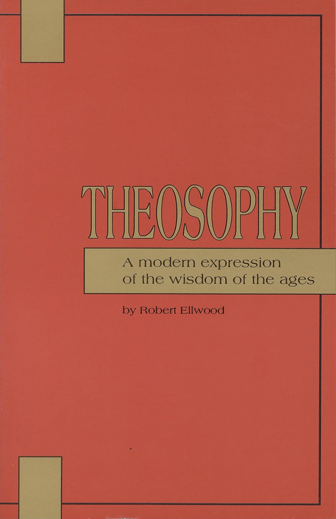
Theosophy
A Modern Expression of the Wisdom of the Ages
By Robert Ellwood
Excerpt
Excerpt
“This book is about an ancient wisdom tradition called theosophy, revived in a modern form in the nineteenth century, which holds that the questions behind the questions can be properly asked, and answered. In the nature of things, the answers can never be absolute, but they can illumine basic principles which help one understand—and joyously live in—this very confusing, buzzing, and imperfect world.
This wisdom shows why, from the vantage point of one “at ground level” in our world, life in that world appears like little more than journeys from birth to death as generations follow one after the other. It enables us to understand the roles of suffering and joy in such a world, showing us that the contexts of our lives, in both space and time, are far deeper and more wonderful than we might have thought. It points to the significance of consciousness as a basic key to understanding reality and how this puts our tribulations and hopes in a new light. Minds—our own minds—are not just flashlights spotting a few scattered surfaces out there in a dark universe, but lamps that illumine its true nature from within.
In theosophical teaching, the fact that despite all its clutter the universe holds together at all means it must have some unifying principle. This tradition goes on to say that the fact that we are conscious means that consciousness must be an integral part of the universe, for we are parts of it, its children. Therefore we ought to be able to find out something of how the universe really works, not only by looking outside, as it were with a flashlight on a dark night, but also by looking deep within to discover our own nature.”
Essence
Essence
The universe is vaster and more purposeful than you may have imagined – and theosophy points the way to living in all its wonder.
Theosophy: A Modern Expression of the Wisdom of the Ages is a work of genuinely accessible scholarship – no small achievement considering the subject matter is famous for its depth and complexity. Written by Robert Ellwood, PhD – a leading scholar of comparative religion and a longtime member of the Theosophical Society – it is both a rigorous survey and a deeply personal encounter with the theosophical tradition. Drawing on the Blavatsky lineage as developed through the Theosophical Society at Adyar, Ellwood presents not a fixed dogma but a living orientation: a profoundly optimistic affirmation that the great questions of human existence – “What is Reality? What is a human being? Where did we come from and where are we going?” – can be properly asked, and that meaningful, if never absolute, answers can be found. At the heart of the theosophical worldview is the primacy of consciousness: minds are not flashlights in a dark universe, but lamps that illumine its true nature from within. As stewards of the Theosophical Society Library of England & Wales, LightEn highlights this work for its clarifying scholarship and comparatively modern survey of theosophical wisdom and its implications for daily life.
Embodiment: Living the Wisdom
Embodiment: Living the Wisdom
In Theosophy, Robert Ellwood grounds each dimension of the tradition in both its historical sources and its living relevance. The chapter on “Theosophical Foundations” lays out the key principles with care: the omnipresence of consciousness, the brotherhood of humanity, the reality of karma and reincarnation, and the existence of a reservoir of wisdom accessible to earnest seekers. These are not presented as articles of faith but as orientations – the tradition’s confidence being that honest inquiry, pursued with sufficient depth, will bring the seeker to recognise their truth from within.
Early on, Ellwood asks and answers a common question: “How does one set foot on the great path?” He suggests most spiritual traditions are upheld by two pillars: wisdom and compassion. True wisdom, he explains, is prajna, or prajnaparamita: not verbal knowledge about philosophical truths, however profound, but “awareness which begins with awareness of one’s own true nature as one with the true nature of the universe.” Its twin is compassion – “feeling with” – grounded in the recognition that “what the other suffers I must suffer, and that what I do for the other I do for myself, since our lives are bound together and share the same divine nature.” The two cannot be separated: “any supposed wisdom that does not express itself in compassionate behavior is false, no wisdom at all.” The path, Ellwood writes, “rests on knowing and doing; it is a process of growing in wisdom and love expressed in action. The twin supports of these are meditation and service, underwritten by study and effort.”
The final section on “Theosophical Living” unites the book’s core teachings – on consciousness, karma, the path, and the inseparability of wisdom and compassion – into a practical, engaged way of life. Its five principles – duty, service, expression, naturalness, and fellowship – are, Ellwood writes, finally “one principle—a way of seeing which is inseparable from a way of doing, wherein the one spontaneously engenders the other.” Central to this is the concept of svadharma, one’s own personal dharma or calling in the world: “something each individual is supposed to do, something that, if one fails in this duty, will not be done and the entire world will thereby be set back by so much.” Ellwood points to Henry Steel Olcott, who, despite his duties as first president of the Theosophical Society, found time to labour on behalf of Buddhists in Ceylon against the opposition of imperial Britain, and to Annie Besant, his successor, who fought for education and home rule in India despite hostility from her own countrymen and a brief prison term during the First World War. They are but two examples of theosophists for whom “the call to dharma was a call to evolutionary change rather than to resignation.” Theosophy, he explains, has “generally been on the side of freedom, democracy, education, and human rights, favoring responsible reforms in these directions. Knowing that change is always happening in an evolutionary universe, yet also that we humans can have much to say about what kind of change takes place on our own level, theosophists seek to ‘push’ change in helpful directions.”
Theosophy lays down no law; one’s morality must grow from spiritual maturation rather than prescription. What it offers is a worldview with “two great complementary benefits for satisfactory daily living” – the reassurance that evolution toward the Good is taking place across time, and the conviction that “nothing is trivial”: every act of good, however small, augments through its wholesome karma “our own evolution and that of the world – toward unimaginable splendors to come.”
For those wishing to engage more deeply with the theosophical tradition, the Theosophical Society, founded in 1875, continues to provide community, resources, and events via local and national branches across the globe and online.

“The particular style of wisdom and compassion which theosophy tends to nurture in its adherents is both activist and evolutionary. It has generally been on the side of freedom, democracy, education, and human rights, favoring responsible reforms in these directions. Knowing that change is always happening in an evolutionary universe, yet also that we humans can have much to say about what kind of change takes place on our own level, theosophists seek to ‘push’ change in helpful directions.”