Title details
Original Publication Date:1904
Edition Reviewed:Theosophical Publishing Society, 1912
Translator:Max Gysi
Print Length:237 pages
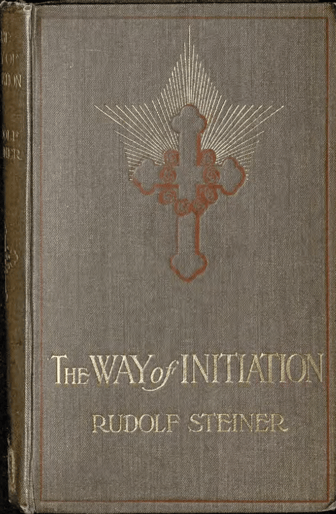
The Way of Initiation
Or How to Attain Knowledge of the Higher Worlds
By Rudolf Steiner
Experience the Book
Excerpt
Excerpt
“The Path stands open to all who earnestly will to enter it.
Simple, in truth, is the rule concerning moments of inner calm, and easy it is to follow; but it only leads to the goal when the pursuit is as earnest and strict as the way is simple. … The student must mark off a small part of his daily life in which to occupy himself with something quite different from the avocations of his ordinary life, and the way in which he occupies himself at such a time must also differ from the way in which he performs the rest of his duties. […] If any person really has no more time at his disposal, five minutes a day will suffice. The real point is the manner in which these five minutes are spent.
[…] The student must endeavour to attain the power of regarding himself at certain times as he would regard a stranger. He must contemplate himself with the inward calm of the critic. When this is attained, our own experiences present themselves in a new light. As long as we are interwoven with them and are, as it were, inside them, we are as closely connected with the unreal as with the real. […] It is as though we had spent the whole day in a place where we saw the smallest objects at the same range of vision as the largest ones, and in the evening climbed a neighbouring hill and surveyed the whole scene at once. […]
For in every human being there is, besides what we call the work-a-day man, a higher being. This higher being remains concealed until it is awakened. And each of us can only awaken it for himself.”
Essence
Essence
Higher worlds are not hidden from you – only your capacity to perceive them remains unawakened.
The Way of Initiation (later published as How to Know Higher Worlds) is Rudolf Steiner's guide to developing the latent faculties through which the higher worlds become as knowable as the world you perceive with your physical senses. Steiner – philosopher, scientist, and future founder of Anthroposophy – wrote it while serving as General Secretary of the German Section of the Theosophical Society, at a point when his focus turned from philosophy to practical spiritual science. The work is addressed to the person who will accept nothing on faith or authority but is willing to do the inner work – patiently, seriously, and without a guru. Steiner’s argument is that the higher worlds are not hidden; it is the organs of perception that remain undeveloped. The work moves from the Path of Reverence and the daily practice of inner calm, through increasingly demanding exercises, to the trials of Initiation itself. It does not estrange you from daily life. It returns you to it – with steadied attention, and eventually with the direct perception that the higher worlds are real. As stewards of the Theosophical Society Library of England & Wales, LightEn is making available an early edition of The Way of Initiation – the 1912 authorised translation with a foreword from then-President of The Theosophical Society, Annie Besant.
Embodiment: Living the Wisdom
Embodiment: Living the Wisdom
The Way of Initiation opens with the sceptic's challenge: prove it. Steiner's answer is that the superphysical world is not a matter of belief but of knowledge – knowledge that is inaccessible not because it is withheld, but because the faculties required to perceive it lie dormant in most human beings. The path to developing them requires no mystery school, no master: “The Path stands open to all who earnestly will to enter it.”
From the very beginning, the student is directed to the “Path of Reverence” and the development of the inner life – learning to stand before wisdom, beauty, or another person without rushing to judge, allowing what you perceive to speak first. From this grows the daily practice of inner calm: a small portion of time set apart, in which you learn to regard your own experiences as though they belonged to a stranger. “In esoteric studies, everything depends on the energy, inward truthfulness, and uncompromising sincerity with which we contemplate ourselves and our actions from the standpoint of complete strangers.”
From this practice the work deepens. You are asked to direct sustained attention alternately to germinating, flourishing life and to fading, dying life – surrendering completely to each impression in turn, until distinct feelings arise from each. “Just as natural forces evolve out of living matter the eyes and ears of the physical body, so will the organs of clairvoyance evolve themselves from the feelings which are thus evoked.” Through patient contemplation of stone, plant, and animal, the inner eye begins to perceive what each emanates. And as the practice deepens further, the student learns to listen so completely that the inner world opens – what Steiner calls the moment of being “born anew,” when an inner light floods the whole external world.
The trials of Initiation test what has been built. The third and most demanding requires the student to find every resource within themselves alone, with no outer support of any kind. What Initiation finally confers is the capacity to meet each new experience unclouded by habit – to hold the truths of the higher worlds not as doctrine but as living perception.
The training is completed in character. “Every idea which does not become an ideal for you, slays a power in your soul: every idea which becomes an ideal creates within you living powers.” The conditions of discipleship – patience, gratitude, and the recognition that your thoughts and feelings act on the world as surely as your deeds – are not rules imposed from outside. They are the natural shape of the soul the path itself calls forth. “It is not of so much importance to achieve a great deal in a given time, as to be earnest in the search.” The student who follows this training does not become otherworldly. They become more fully present to the life they already live – and certain, from direct experience rather than faith, that the higher worlds are real.
For anyone seeking deeper engagement with Steiner's wide-ranging and influential body of work, the Anthroposophical Society offers online study programmes and a thriving global community.

“In esoteric studies, everything depends on the energy, inward truthfulness, and uncompromising sincerity with which we contemplate ourselves and our actions from the standpoint of complete strangers.”