Excerpt
Excerpt
“There are many people who will say that the concept of the free person I am developing here is a chimera, which is seen nowhere in life. We live among real people, in whom morality is only to be hoped for when they abide by a moral commandment, when they regard their moral mission as a duty and do not freely follow their inclinations and their love. I do not doubt that for a second. Only a blind person could. But then let us dispense with all the hypocrisy about morality. Just say that human nature must be forced into its actions, as long as it is not free. It does not matter whether this unfreedom is imposed by physical means or through moral laws; whether a person is unfree because they are following their boundless sex drive or because they are shackled by the chains of conventional morality. But one cannot claim that such a person is right to call an action their own, when they are driven to perform it by an external force. But from the midst of this coercive order the free spirits arise, though they are surrounded by a jumble of morals, legal compulsions, religious practice etc. They are free insofar as they follow only themselves; and unfree insofar as they subordinate themselves. Which of us can say that they are really free in all their actions? But in each of us there dwells a deeper essence in which the free person speaks.”
Essence
Essence
Through thinking, you co-create reality; through intuition, you act freely within it.
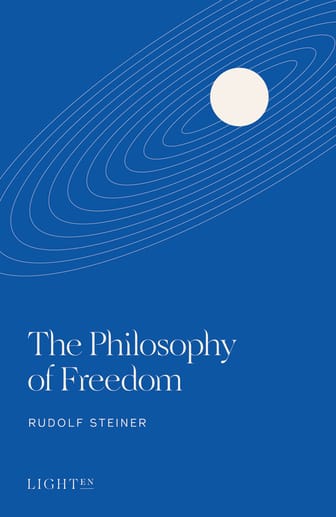
The Philosophy of Freedom is Rudolf Steiner’s foundational philosophical work. Written before founding Anthroposophy, when he was thirty-three and editing Goethe’s scientific writings, the book sets out to answer a single question: are you truly free – and if so, how? Steiner’s answer turns on a discovery about thought itself. Every other thing you observe appears to you from outside, already formed; but when you observe your thinking, you are watching something you yourself are making. This self-transparency is unique. From it, Steiner builds the case that moral freedom is real, and that it is achieved, not given: not by obeying laws or following instincts, but by acting from intuition – from ideas grasped directly and made your own. The book moves in two parts: the first shows that thinking is the one domain in which you can know a thing from the inside; the second shows how this capacity grounds an ethics of individual freedom, in which, as Steiner puts it, “We are truly human only insofar as we are free.”
Embodiment: Living the Wisdom
Embodiment: Living the Wisdom
In The Philosophy of Freedom, Steiner does not ask you to believe anything; he asks you to observe: “It is observation through which we first become aware of everything that enters the realm of our experience.” Early on, he establishes an important distinction and relationship between ‘percept’ and concept. A percept is the immediate content of observation – the observed object as it presents itself, before thinking has done anything with it. He is careful to note that this is broader than sensation in the physiological sense: feelings and even thoughts, when first encountered through observation, are also percepts. But a percept alone is incomplete. As Steiner puts it: “The percept is thus not finished and complete in itself; it is one side of the total reality. The other side is the concept. The act of knowledge is the synthesis of percept and concept, and only these two together make up the whole.”
This leads Steiner to elucidate his sense of monism: the world is not divided into an inner realm of mind and an outer realm of matter, with an unbridgeable gap between them. Percept and concept are two sides of a single reality, and knowledge is what unites them. When you think about what you observe, you are not adding something subjective to something objective – you are completing what is there. “Thought transcends subject and object. It generates these two concepts as it does all others.” And because monism refuses to seek the principles of knowledge beyond human experience, it refuses to seek the principles of morality beyond it either. “For the adherents of monism, morality is a specifically human quality, and freedom is the human form of being moral.” This is not a lowering of the moral bar – it is a radical claim about what morality actually is. “Monism does not see humans as finished products that realise their full potential at every moment of their lives, and so the argument about whether humans are free as such or not is futile. Monism sees humans as developing beings, and asks whether, in the course of this development, the stage of the free spirit can be attained.” As Steiner puts it simply: “Each of us is called to be a free spirit, just as every rosebud is called to become a rose.”
The second part of the book articulates the application of this wisdom in one's life. Steiner presents what he calls ‘ethical individualism’: the view that genuinely free action cannot be derived from universal moral rules or external commandments, but only from individual moral intuition – a direct perception of what any given situation calls for. “I do not check whether my action is good or evil; I carry it out because I am in love with it.” Steiner is not calling for self-indulgence, but the disciplined development of certain uniquely human capacities, including:
- Moral intuition: the ability to grasp a moral idea directly, without deriving it from a rule or commandment. “Anyone lacking the ability to create their own particular moral maxims for an individual case will also never exercise a truly individual will.”
- Moral imagination: the creative capacity to translate that idea into a response fitted to the actual situation. “In order to realise their ideas and put them into action, the free spirit needs the moral imagination. This is the source of action.”
- Moral technique: the practical ability to carry the response through in the real world. “Moral action thus presupposes … the ability to reshape the world of percepts without breaking the laws of nature that hold it together. This ability is moral technique, and it may be learnt just as science itself may be learnt.”
Ultimately, The Philosophy of Freedom, one of Steiner’s earliest works, forms the foundation of his comprehensive and rigorous spiritual science. For anyone seeking deeper engagement with Steiner's wide-ranging and influential body of work, the Anthroposophical Society offers online study programmes and a thriving global community.

“Our lives are made up of free and unfree actions. But we cannot think the concept of the human through to its logical conclusion without coming upon the free spirit as the purest manifestation of human nature. We are truly human only insofar as we are free.”