Title details
Original Publication Date:2018
Edition Reviewed:Waterside Publishing, 2023
Print Length:308 pages
Image Credit:p. 217
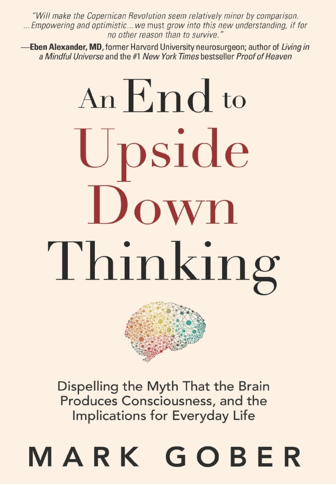
An End to Upside Down Thinking
By Mark Gober
Experience the Book
Excerpt
Excerpt
“An obvious part of your existence is that you are here, right now, having an experience. Whether space, time, matter, or anything else is ‘real’ is up for debate, but it is undeniable that you are reading these words, having an experience as the ‘I’ who is reading them. ‘I’ indisputably exists as the experiencer right here and right now. It is your ultimate identity. […]
Can we define ‘I’ as our thoughts? Right now, you are thinking about this book. Earlier you were thinking about your family. Before that you thought about your job. Your thoughts change. But the ‘I’ that was having the thoughts did not change. ‘I’ has always been there during your sea of changing thoughts. Therefore, we cannot equate ‘I’ with your thoughts. ‘I’ experiences the thoughts, but is not made of the thoughts.
Is ‘I’ my body? My body today is not the same as it was five years ago. It is not the same as it was 20 years ago … But in all cases, ‘I’ was present. ‘I’ hasn't changed, but my body has… Therefore ‘I’ cannot be equated with my body. ‘I’ experiences the body, but ‘I’ is not the body itself …
So, our own introspection tells us that ‘I’ has the following characteristics: It is unlimited, self-aware, infinite, and eternal… Religions — across cultures — have a name for an unlimited, self-aware, infinite, and eternal being. The name they give for that being is: ‘God.’”
Essence
Essence
You are not a body that has consciousness – you are consciousness having the experience of a body.
Mark Gober, a Princeton-educated investment banking analyst, spent years investigating the evidence for psychic phenomena, near-death experience, and the survival of consciousness beyond the body, and became convinced that mainstream science has the relationship between mind and matter the wrong way round. Drawing from peer-reviewed studies, declassified government programmes, and physicist David Bohm's notion of reality as an unbroken wholeness rather than separate parts, what he found is that the materialist assumption built into modern science – that the brain produces consciousness – is not just unproven but almost certainly backwards. Consciousness is not a by-product of the brain. The brain is a filter, a localising mechanism for something far more primary. Whether Gober is tracing a psychic describing a distant location or a child recalling a life that checks out against historical record, the evidence keeps pointing toward the same, world-inverting conclusion: consciousness comes first, not matter. Everything else, including you, exists within it.
Embodiment: Living the Wisdom
Embodiment: Living the Wisdom
A distinctive quality of An End to Upside Down Thinking comes from Mark Gober's background. Neither mystic nor scientist, he was a Wall Street analyst trained in evidence and scepticism; a self-described materialist. But then he took an interest in consciousness research and – as he was well-trained to do – he went deep into analysing the data.
Gober builds his case chapter by chapter, starting from the ground up. The materialist worldview – that matter is fundamental and the brain produces consciousness – is so ingrained that it rarely gets questioned. Gober questions it: there is no evidence that the brain produces consciousness, only correlation, and correlation cannot tell us which one causes the other. That unexamined assumption is where the crack begins: "We don't know how physical, seemingly unconscious matter creates a nonphysical consciousness." From there he turns to the evidence itself, beginning with remote viewing, tested for 24 years under a U.S. government programme once codenamed Stargate. Its results – including a psychic named Ingo Swann sketching a classified cryptographic site and describing a Chinese atomic bomb test three days before it happened – were later confirmed by declassified CIA documents. Alongside this sit controlled studies in telepathy, precognition, and psychokinesis conducted at Princeton, Cornell, Stanford, and the University of Virginia, among others, with statistical support that exceeds the evidence behind more mainstream findings, such as aspirin's ability to prevent heart attacks.
The book's second movement examines what happens at the boundary of physical life. Patients with no measurable brain activity report lucid, verifiable perceptions – among them Pam Reynolds, whose brain and body were fully shut down for a rare surgical procedure, who later described the specific instruments used and conversations she had no way of hearing. Mediums are tested under triple-blind conditions. And at the University of Virginia, the psychiatrist Ian Stevenson spent decades investigating more than 2,500 children around the world who recall details of previous lives with striking historical accuracy – work his successor, Jim Tucker, continues today. Taken together, the evidence points toward a consciousness that is not localised to, or extinguished by, the body.
Gober also draws out what the data implies for how you actually live. If consciousness is one and undivided rather than private to each brain, then the separateness you feel from other people is an illusion – harming another is, in a real sense, harming yourself, and helping another is helping yourself. The practical stakes could not be higher. As he writes: "I view the belief that we are finite and separate to be the disease underlying virtually every problem in human society today. Anxiety, depression, interpersonal problems, racial and social prejudices, gender inequality, geopolitical unrest, violence, war, greed, or nearly any problem you can think of — at their core are symptoms, not the disease." The inversion this book asks of you is not merely intellectual; it is the ground from which a different way of being in the world becomes possible.
For further exploration of the evidence, Gober's 2019 podcast series Where Is My Mind? takes up the same questions across eight episodes, examining the scientific case for telepathy, the afterlife, and beyond.
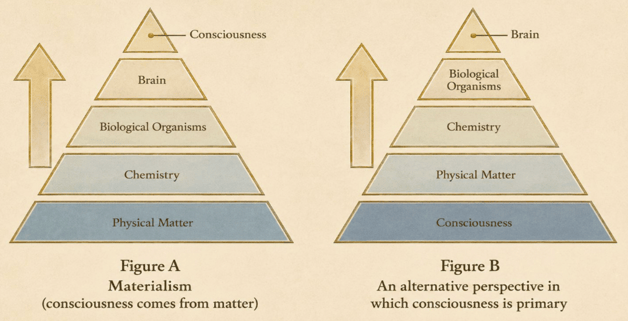

“We do not need to give up what we have learned in physics, chemistry, biology, or neuroscience; we are simply recontextualizing these disciplines. All we do is invert the order: consciousness comes first, not matter.”