Title details
Original Publication Date:1991
Edition Reviewed:Quest Books, 1991
Print Length:213 pages
The Personal Aura
By Dora van Gelder Kunz
Excerpt
Excerpt
“No human being is without feelings. From a baby’s first cry to a dying person’s last look at friends and family, our primary response to the world around us is colored by emotion. Whether that world seems to us friendly or frightening, beautiful or ugly, pleasant or disagreeable affects the way we approach others, and indeed influences everything we do. I do not believe that such feelings arise in us solely due to environmental conditions, or to genetic factors, however important these both may be. Members of the same family, placed in the same kinds of situations, react in very different ways. Our emotions are a conscious response to our experience, but they are self-generated and reveal something important about our character. To me, the emotions are 'real' in the sense that I can perceive them objectively as a luminous atmosphere surrounding every living being. Because of its luminosity, this material has traditionally been called ‘astral’ – i.e., ‘shining’ – in theosophical literature. Every time we feel an emotion there is a discharge of energy in the emotional field, whether slight or strong, and this produces a characteristic vibration and a color – the 'footprint' of that particular emotion.”
Essence
Essence
A luminous cloud of colour surrounding you reveals what emotions truly are: not mere psychological states but living energies with real physical consequences.
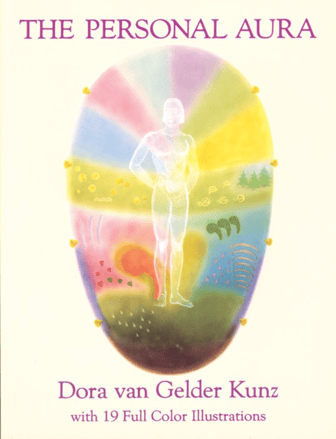
Dora van Gelder Kunz possessed clairvoyant sight from childhood, perceiving the “luminous cloud of color surrounding each of us” as naturally as ordinary vision. In The Personal Aura, she synthesises six decades of her work alongside medical practitioners, accompanied by 19 full-colour paintings that document the emotional field’s intricate patterns. Co-founder of Therapeutic Touch with Dolores Krieger, RN, Kunz brings both esoteric knowledge and clinical rigour to mapping consciousness through colour and form. The book unfolds systematically: the structure of human energy fields (etheric, emotional, mental, intuitive), the mind-emotion interplay, case studies revealing how trauma, creativity, meditation, and illness shape the aura, and practical methods for conscious transformation. Central to her vision: “everything – including ourselves – exists in terms of this greater whole, which is the universe itself” and “individuals can take their lives into their own hands, put their intentions into practice, and make their aspirations a force for personal change.” More than documenting subtle energies, Kunz shows how understanding the aura illuminates the hidden dimensions within us and awakens our ability to heal and to consciously effect change. As stewards of the Theosophical Society Library of England & Wales, LightEn is highlighting this work from Dora Kunz, an influential theosophical leader and healer, whose clinical work via the framework of Therapeutic Touch continues to be practiced by healthcare professionals today.
Embodiment: Living the Wisdom
Embodiment: Living the Wisdom
In The Personal Aura, Dora van Gelder Kunz shows that her way of seeing is not a private gift but a discipline you can bring to your own emotional life. She maps the aura as an ovoid of light extending some twelve to eighteen inches from the body, structured into an upper hemisphere holding your innate character and a lower hemisphere shaped by daily experience. The two halves are joined by a green band at the waist, whose width and shade, Kunz writes, show “the degree to which we are at that point in time able to express ourselves in the world” – “yellow-green for intellectual activity, blue-green for artistic creation, darker green for physical labor.”
Her working vocabulary of colour, drawn from decades of case-by-case observation, offers a key into habitual feelings: scarlet for anger, rose for affection, golden yellow for understanding, brown for “selfishness, self-centeredness,” lavender for “spiritual aspiration and intuition.” The location of a colour is also significant. Kunz notes that “when the colors extend right to the edges of the aura, this indicates that these emotions are being used freely,” but “when they remain close to the body, enclosed by other colors… the emotions they represent are inhibited and ineffective in daily life.”
The way to put this knowledge into practice, Kunz suggests, is honest self-awareness – watching yourself at the moment a strong feeling actually rises, rather than examining it once it has settled into habit. When anger surfaces, she recommends admitting it outright: “I am angry, but I am not going to give in to it or let it dominate me.”
The discipline she returns to again and again is centring: withdrawing attention into the heart, “the seat of spiritual as well as physical life,” which she describes not as a narrowing of focus but an expansion – “a circle whose center is everywhere and whose circumference is nowhere.” She offers a specific visualisation for a painful memory: withdraw into the heart as a point of light, picture the memory as detached and outside yourself, then let rays of light shine through it until it dissolves – a practice she extends outward, too, to anyone who is ill or in distress.
Kunz draws from her lifetime of healing work to illustrate how emotional patterns affect physical health. Anxiety, for example, creates “an emotional vortex, and this in turn reduces the free flow of energy within the aura,” directly affecting organs through the etheric field. Therapeutic Touch, a holistic, evidence-informed practice, emerged from this understanding and a desire to help. Healing through Therapeutic Touch doesn’t impose one’s will but removes impediments to the body’s innate order. The healer cultivates empathy and compassion, while maintaining detachment from the outcomes, becoming an instrument rather than an agent. To learn more about these healing practices, the Therapeutic Touch International Association offers training, workshops, and a practitioner community worldwide.
The Personal Aura bridges mystical, clairvoyant perception and embodied practice. Through understanding energy fields’ language – colour, form, movement – you can gain literacy in your own inner life. The work invites direct experience: notice emotional patterns, practice centring, visualise wholeness, observe shifts. Kunz’s decades observing thousands of auras distil into a practical wisdom: consciousness shapes the subtle field, and what we become aware of, we can change.
“What I try to do in this book is share with you something of my perception and appreciation of the hidden dimensions of consciousness within us, and in so doing, make you more aware of these aspects of your own life, and of your ability to effect conscious changes in yourself.”

“We are never isolated unless we become so deliberately; we can always reach out to another person through our feelings, even when words are useless for communication.”