Title details
Original Publication Date:2008
Edition Reviewed:Sounds True, 2010
Print Length:219 pages
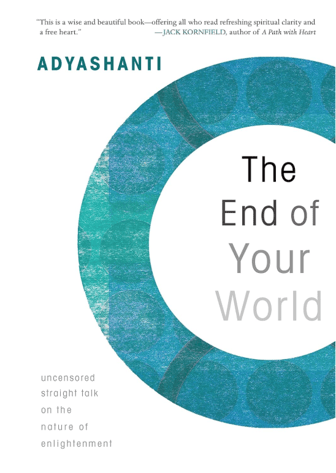
The End of Your World
Uncensored Straight Talk on the Nature of Enlightenment
By Adyashanti
Excerpt
Excerpt
“The moment of awakening may or may not result in a permanent seeing. [...] some people will tell you that unless it’s permanent, the awakening is not real. What I’ve seen as a teacher is that the person who has a momentary glimpse beyond the veil of duality and the person who has a permanent, ‘abiding’ realization are seeing and experiencing the same thing. One person experiences it momentarily; another experiences it continuously. But what is experienced, if it is true awakening, is the same: all is one; we are not a particular thing or a particular someone that can be located in a particular space; what we are is both nothing and everything, simultaneously.
So, as I see it, it doesn’t really matter whether an awakening is instantaneous or continuous. It matters in the sense that there is a trajectory–nobody’s heart will be fulfilled until that perceiving from the point of view of truth is continuous–but what is seen is an awakening, whether it is sustained or not.
This glimpse of awakening, which I call nonabiding awakening, is becoming more and more common. It happens for a moment, an afternoon, a day, a week–maybe as long as a month or two. Awareness opens up, the sense of the separate self falls away–and then, like the aperture on a camera lens, awareness closes down. All of a sudden that person who had previously perceived true nonduality, true oneness, is quite surprisingly now perceiving in the dualistic 'dream state.' In the dream state, we’re back in our conditioned sense of self–in a limited, isolated sense of being.”
Essence
Essence
An experience of awakening is not the end goal; it is the beginning of a new kind of journey.
Written to address common misunderstandings of awakening, Adyashanti’s The End of Your World shows that the road to genuine enlightenment is far more disruptive, humbling, and transformative than most imagine. It is not bliss or a spiritual trophy to hold over others but the dissolution of the egoic structures that have shaped your life – and it is rarely a one-time event. Adyashanti writes, “The vast majority of people who experience awakening will, at some point, find their conditioning arising again,” and, “There is no such thing as past awakening; past awakening is past. The only thing that is relevant is the present.” Awakening must be continually rediscovered, for it breaks you open, exposing unconscious fears and illusions and demanding a raw honesty that can feel like losing the ground beneath you. Yet this upheaval becomes the gateway to freedom: a life lived from a place of clarity, responsiveness, and stillness rather than conditioning or control, inviting you to trust the intelligence of awakening even as it dismantles everything familiar.
Embodiment: Living the Wisdom
Embodiment: Living the Wisdom
As a spiritual teacher for decades, Adyashanti has seen many students use moments of awakening as a reason to avoid their own inner work. Against this tendency, he insists, “If there is anything that is unresolved in yourself, turn toward it. Face it. Look at it. Stop avoiding it. Stop moving the other way. Stop using a moment of awakening as a means to not deal with something that may be less than awake within you… We need to really want the truth. We need to want the truth even more than we want to experience the truth.” Believing that a past awakening has liberated them from the ego, students often underestimate how quickly “Velcro” thoughts can pull them back into illusion. Awakening, he says, is like a rocket that could break free of gravity – yet the ego’s gravitational pull usually drags people back. Some even become proud of their ‘awakened’ status, feeding the very ego they believe they’ve transcended. For this reason, he counsels that “our greatest ally is a deep and profound sense of sincerity. With sincerity, we’re able to recognize that this superiority is a form of arrogance, a way the mind is using insight to hide”.
For Adyashanti, the process he describes is a gradual movement “from nonabiding to abiding awakening”, the effect of which he calls becoming “undivided”. Characteristically, he cautions against expectations and images of what we might assume this to look like, for ourselves, and even of spiritual teachers such as himself: “to be undivided does not mean to be perfect. Being undivided does not conform to images we might have in our mind about holiness or perfection. If someone were to look at my life, I’m sure they could come up with lots of reasons to say something like, ‘Oh that doesn’t fit my idea of what an enlightened being would be. That doesn’t fit my image of what an undivided being is like’. [...] To me, part of awakening is dying into ordinariness, into nonanxiety. Regardless of what someone might say looking at my life or anyone else’s life, the state of nondivision is not something you can understand until it starts to wake up within you.”
Adyashanti further explains that he isn’t seeking to become anyone's external authority. His role, as he puts it, is to offer hints and clues from his own journey, and to simply question what you think you know, ultimately delivering your attention back to yourself. Hints can take the shape of helpful practices as you navigate the back-and-forth of re-identification, and find yourself triggered along the way. He suggests a writing exercise that helped him: “When I would go to the coffee shop with a pad of paper and a pencil, I would get very specific about exactly what the thought was that caused that moment of reidentification, and I would start to write about it. I would look at exactly how that thought viewed the world. To do that, I would have to enter into how I felt. I would have to zero in on what believing that particular thought–be it condemnation or embarrassment or what have you–generated at the feeling level. Then I would enter into the feeling and allow myself to feel the feeling... I discovered that the feeling had a voice in my mind, and I discovered that it had certain specific beliefs and ideas.”
Although abiding awakening can take years (Adyashanti says it took six years for him), if you are persistent, you will perceive the unity of all things increasingly displace the false thoughts that keep you clinging, grasping, and feeling separate. Over time, you are truly reborn into a steady experience of consciousness that defies description. For those who have embarked upon the spiritual path, The End of Your World is a straight-talking companion for the journey ahead, a demystification of the process that all too often follows an awakening experience. For further resources from Adyashanti, his recorded talks, courses, and writings are available through Open Gate Sangha.

“To be less than truthful with the people and situations in your life is to withhold the expression of who you are. In the end, we must come to see that truth itself is the highest good, that truth itself is the greatest expression and manifestation of love. Ultimately, love and truth are identical; they are like two sides of a coin.”