Title details
Original Publication Date:1966
Edition Reviewed:Souvenir Press, 2009
Print Length:163 pages
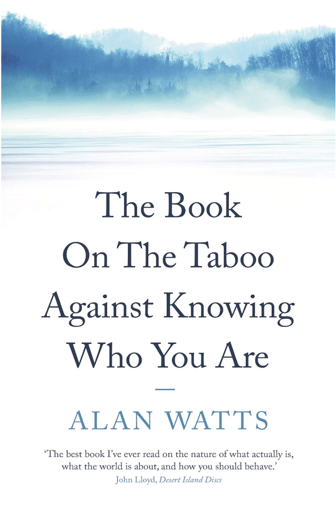
The Book On the Taboo Against Knowing Who You Are
By Alan Watts
Excerpt
Excerpt
“The startling truth is that our best efforts for civil rights, international peace, population control, conservation of natural resources, and assistance to the starving of the earth—urgent as they are—will destroy rather than help if made in the present spirit. For, as things stand, we have nothing to give. If our own riches and our own way of life are not enjoyed here, they will not be enjoyed anywhere else. Certainly they will supply the immediate jolt of energy and hope that methedrine, and similar drugs, give in extreme fatigue. But peace can be made only by those who are peaceful, and love can be shown only by those who love. No work of love will flourish out of guilt, fear, or hollowness of heart, just as no valid plans for the future can be made by those who have no capacity for living now.
The separate person is without content, in both senses of the word. He lives perpetually on hope, on looking forward to tomorrow, having been brought up this way from childhood.”
Essence
Essence
Trying to improve yourself, let alone the world, is like trying to bite your own teeth.
Alan Watts had a gift for making the most radical idea in the world feel like an enormous relief. The Book On the Taboo Against Knowing Who You Are is his most famous statement of that idea: the sensation of being a separate self – a little ego, marooned inside a bag of skin, peering out at an alien universe – is a hallucination; what Watts calls “an unrecognised but mighty taboo—our tacit conspiracy to ignore who, or what, we really are.” Described as “a cross-fertilisation of Western science with an Eastern intuition,” The Book draws on Vedanta philosophy in conversation with the systems thinking and cybernetics emerging in the 1960s, to make the case that the separate ego is not a fact of nature but a social fiction – installed so early and so thoroughly that we mistake the “ego-feeling” for reality. What distinguishes The Book is Watts’ quality of holding it all with levity and humour. He doesn’t tell you to try harder, meditate longer, or purify yourself of the ego. He points out – with considerable amusement – that the ego trying to dissolve itself is the very illusion that needs dissolving. Let the wisdom in The Book work on you like a good joke – it's when you're not trying to get it that you do.
Embodiment: Living the Wisdom
Embodiment: Living the Wisdom
Watts’ teaching begins with recognising that our “normal sensation of self is a hoax, or, at best, a temporary role that we are playing, or have been conned into playing—with our own tacit consent.” This is not a theory to believe but an illusion to see through. He compares it to discovering you’ve been hypnotised: the separate ego is a social institution with about as much reality as a bank balance.
Watts explains that it is our conscious, narrowed attention that perpetuates the illusion of separateness in the universe. Our ordinary mode of “attention is narrowed perception. It is a way of looking at life bit by bit, using memory to string the bits together—as when examining a dark room with a flashlight having a very narrow beam.”
The result is a world experienced as opposition, rather than polarity, which fuels an impulse to improve, control, eliminate, or avoid what we do not like. Because attention scans life piece by piece, it loses sight of how each part belongs to a larger, interconnected whole. Watts explains:
“Rarely do we see all so-called things and events ‘going together,’ like the head and tail of the cat, or as the tones and inflections—rising and falling, coming and going—of a single singing voice.
In other words, we do not play the Game of Black-and-White—the universal game of up/down, on/off, solid/space, and each/all. Instead, we play the game of Black-versus-White … Then, not realizing the inseparability of positive and negative poles of the rhythm… It is a fight—a fight haunted by a sense of chronic frustration, because we are doing something as crazy as trying to keep the mountains and get rid of the valleys.”
The game of Black-versus-White is predicated on a misunderstanding – and seeing through it is what Watts means by a genuinely transformed relationship with the world. You recognise that “the world beyond the skin is actually an extension of our own bodies.” Your breath is the atmosphere, your food is the soil and sun, your thoughts arise from the entire field of culture and language. The relationship between organism and environment is always mutual – neither one is cause or determinant of the other, because the arrangement between them is polar. Seeing this transforms how you relate to everything: you stop, for example, trying to conquer nature when you recognise nature is not other than you.
Embodiment arises organically as spontaneous action, rather than effortful striving. When the illusion of the separate doer drops away, “a third response is possible. Not withdrawal, not stewardship on the hypothesis of a future reward, but the fullest collaboration with the world as a harmonious system of contained conflicts.” This collaboration isn’t a duty or a discipline – it is what naturally arises when the self stops fighting the world it is made of. And with that comes something Watts clearly felt himself: a sense of joy and wonder at the sheer improbability of life and our aliveness. “How is it possible that a being with such sensitive jewels as the eyes, such enchanted musical instruments as the ears, and such a fabulous arabesque of nerves as the brain can experience itself as anything less than a god? And, when you consider that this incalculably subtle organism is inseparable from the still more marvelous patterns of its environment—from the minutest electrical designs to the whole company of the galaxies—how is it conceivable that this incarnation of all eternity can be bored with being?”
Watts established no lineage, initiated no students, and left no meditation centres or communities of practice. His legacy lives primarily through his works and lectures (available through the Alan Watts Organization). This absence reflects his teaching: the recognition of who you are requires no teacher, technique, or tradition – only seeing through the game you’ve been playing. The Book itself functions as what Watts calls “a temporary medicine, not a diet; a point of departure, not a perpetual point of reference.” Read it to have the illusion exposed, then go live from the recognition that you were never actually separate. As Watts puts it, “We do not need a new religion or a new bible. We need a new experience—a new feeling of what it is to be ‘I.’”

“We do not need a new religion or a new bible. We need a new experience—a new feeling of what it is to be ‘I.’”