Title details
Original Publication Date:1949
Edition Reviewed:Harcourt, Brace and Company, 1949
Print Length:399 pages
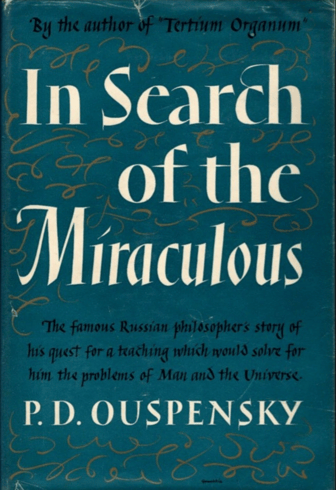
In Search of the Miraculous
Fragments of an Unknown Teaching
By P. D. Ouspensky
Excerpt
Excerpt
“Man is a machine. All his deeds, actions, words, thoughts, feelings, convictions, opinions, and habits are the results of external influences, external impressions. Out of himself a man cannot produce a single thought, a single action. Everything he says, does, thinks, feels—all this happens. Man cannot discover anything, invent anything. It all happens.
To establish this fact for oneself, to understand it, to be convinced of its truth, means getting rid of a thousand illusions about man, about his being creative and consciously organizing his own life, and so on. There is nothing of this kind. Everything happens—popular movements, wars, revolutions, changes of government, all this happens. And it happens in exactly the same way as everything happens in the life of individual man. Man is born, lives, dies, builds houses, writes books, not as he wants to, but as it happens. Everything happens. Man does not love, hate, desire—all this happens. […]
Try to understand what I am saying: everything is dependent on everything else, everything is connected, nothing is separate. Therefore everything is going in the only way it can go. If people were different everything would be different. They are what they are, so everything is as it is. […]
In order to do it is necessary to be. And it is necessary first to understand what to be means. If we continue our talks you will see that we use a special language and that, in order to talk with us, it is necessary to learn this language. It is not worthwhile talking in ordinary language because, in that language, it is impossible to understand one another.”
Essence
Essence
Do you know how it feels to truly remember yourself?
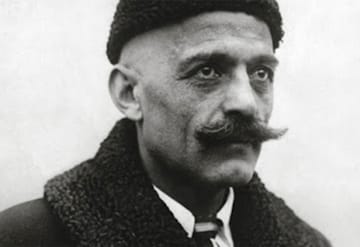
In Search of the Miraculous is P. D. Ouspensky’s record of his eight years (1915-1923) studying with the spiritual teacher G. I. Gurdjieff, whose system of self-development became known as the Fourth Way. When Ouspensky – already an established philosopher and author – returned to Russia after searching for esoteric knowledge in India and Egypt, he met Gurdjieff in Moscow and recognised him as someone who “knew very much of what I wanted to know.” What results is Ouspensky’s systematic account – much of it in the shape of dialogue with Gurdjieff – of the Fourth Way system, including key teachings on self-remembering, the multiplicity of ‘I’s, essence and personality, the four human centres, and waking sleep. The book builds cumulatively and – much like the Fourth Way itself – will most appeal to a committed seeker who is ready to focus their attention and energy rather than casually engage. As Gurdjieff emphasised, “people do not value a thing if they do not pay for it,” and the payment required here is sustained inner work against formidable mechanical resistance.
Embodiment: Living the Wisdom
Embodiment: Living the Wisdom
In Search of the Miraculous reads less like a book of teachings and more a record of being taught: meeting after meeting in St. Petersburg and Moscow, Ouspensky questioning, G. (Gurdjieff) answering, and the reader watching one mind work through its own resistance to what it is being told. G.’s teaching begins by giving the reader a new vocabulary, since ordinary words like ‘man,’ ‘world,’ and ‘consciousness’ are, he insists, too loosely used to carry real understanding. Within G.'s system, humanity divides into seven levels of being, ‘Man number one through seven’ – and everyone starts out as one of the first three, according to which centre governs them: “Man number one means man in whom the center of gravity of his psychic life lies in the moving center… This is the man of the physical body… Man number two means man… in whom the center of gravity of his psychic life lies in the emotional center… Man number three means man… in whom the center of gravity of his psychic life lies in the intellectual center.” Wherever one starts, G. teaches that it is only through deliberate, sustained effort that any person can evolve.
The work begins with self-observation – not the idle introspection we imagine we already do, but systematic observation of our centres: which one is active, are we identified with it, and crucially, do we actually remember ourselves? G.’s words to his students capture the challenge: “Not one of you has noticed the most important thing that I have pointed out to you. That is to say, not one of you has noticed that you do not remember yourselves… You do not feel yourselves; you are not conscious of yourselves. With you, ‘it observes’ just as ‘it speaks,’ ‘it thinks,’ ‘it laughs.’” This discovery – that we move through life without conscious presence, the self that should be aware simply absent – becomes the foundation of practical work. “Self-remembering” means dividing attention: maintaining awareness of oneself while perceiving the external world. The practice is strenuous. Most efforts fail. The machine reasserts control. Yet in rare moments of success, everything changes – colours intensify, sounds become distinct, inner separation from identification occurs. Actual presence blossoms – it is the beginning of awakening from sleep.
G. contrasts his system against three older paths to development – the way of the fakir, the monk, and the yogi. Each demands renouncing ordinary life entirely, and he says, each develops only one part of a person while leaving the rest untouched – “the fakir is master of his body but not of his emotions or his mind; the monk is master of his emotions but not of his body or his mind; the yogi is master of his mind but not of his body or his emotions.” The Fourth Way takes its name because it works on body, mind, and emotion altogether, and it does so inside the very conditions of ordinary life that the other three ways require a person to abandon.
Among the distinctive practices of the Fourth Way are what G. called “sacred dances” – precise, strictly defined sequences of movement in which, he explains, real knowledge is encoded and can be read by those who know how: “in the strictly defined movements and combinations of the dancers, certain laws are visually reproduced which are intelligible to those who know them.” Still taught today as 'the Movements' in Fourth Way groups, these sequences typically ask the body to hold several distinct instructions at once – training, in physical form, the same divided attention that self-remembering asks of the mind.
For those seeking to go deeper and connect with others who are engaged in “The Work”, The Gurdjieff Society, established in the wake of Gurdjieff’s death in 1949, continues the oral transmission of his Fourth Way teachings and maintains in-person groups around the world.

“To speak the truth is the most difficult thing in the world; and one must study a great deal and for a long time in order to be able to speak the truth. The wish alone is not enough. To speak the truth one must know what the truth is and what a lie is, and first of all in oneself. And this nobody wants to know.”