Title details
Original Publication Date:1952
Edition Reviewed:LightEn, 2023
Print Length:330 pages
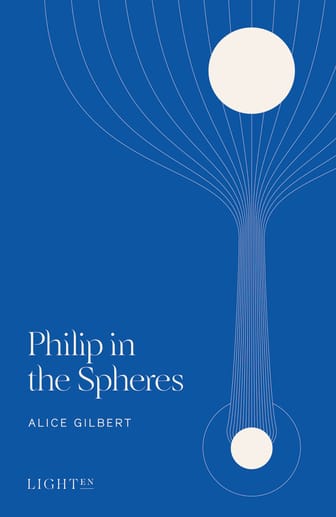
Philip in the Spheres
By Alice Gilbert
Experience the Book
Excerpt
Excerpt
“Let us assume that an average, not very instructed, basically good-hearted person comes over, after a serious illness which has given him warning of approaching death.
He opens his eyes and has the very queer experience of seeing himself outside himself, as I did. Usually one of his relatives or friends is there to meet him and puts him wise at once. He looks round and everything appears much as usual, but he soon discovers that nothing is solid: he can glide through a shut door. […]
He gets almost physically the impact of the grief of his loved ones. It is a terrible sensation: even I who knew a great deal and found my real Ego at once and though you also knew a great deal and reacted in the most helpful way to my death, yet even I felt this terrible — to stand by someone's side and be neither seen nor heard.
That is why it will be so much easier when people in the physical body really understand death and look on it as only a long journey and learn to communicate with us by thought. Much trouble here is caused by people just over, grieving helplessly over the sorrow of those dear to them.”
Essence
Essence
Thought is the creative substance of reality on both sides of death, and love is the means of crossing between them.
When Alice Gilbert's son Philip was killed in a road accident in 1945, their communication did not end – it changed medium. Philip in the Spheres collects three years of nightly telepathic messages that followed the immediate aftermath recorded in Philip in Two Worlds. As Philip's consciousness withdraws from near-earth conditions and rises through successive inner spheres, his messages shift from personal reassurance to sustained teaching about the nature of the world he now inhabits. What emerges is both an intimate portrait of love persisting across death and a detailed, almost technical account of the inner worlds: thought as the creative substance of reality; the mechanics of telepathy; and the hierarchy of spheres from the earth-bound to the luminous beyond.
Embodiment: Living the Wisdom
Embodiment: Living the Wisdom
Philip in the Spheres begins six months after the death of Alice Gilbert's son and it reveals a conversation already in progress. Philip is speaking to his mother across the veil, withdrawing gradually from near-earth conditions, and what he sends back is not only comfort but teaching. Philip’s central message is stated plainly: “the thought force is the source of energy, the creative dynamo.” In the inner worlds he now fully inhabits, what you think strongly is, as far as you are concerned – and if you are powerful enough to mould it into form, you can impose your thought image on others too.
Philip conveys to his mother his firsthand accounts of immediate post-death experience. Those whose earthly lives were organised around material things – money, possessions, physical comfort – find themselves initially trapped in the pseudo-reality their own thought images create. Those whose inner lives ran through music, colour, mathematics, imagination carry on from where they left off, because these activities have direct equivalents in a world made of mind. Philip elaborates with a school analogy: “Being on earth is like being in a lower form at school. While there, one is very absorbed and thinks it tremendously important. When one moves up, at first one is still interested in one's old form, but soon it seems remote, unless one has a brother there. Then one does one's bit to advise and help him. It is only the dunces who yearn to be back.”
As Philip withdraws further he takes on active work – helping disoriented newly-arrived souls, dispelling clumps of negative thought entities, guiding the earth-bound toward the light. His method involves deliberately lowering his own frequency to become visible on the planes where they are stuck, then meeting people inside their own illusions. This is precise, practical welfare work conducted in an inner world, and Philip describes it with the characteristic good humour he brought to earthly life.
The book reaches its apex with the Relays – Philip's great experiment in conveying what he had ultimately become, beyond what any earthly channel could normally carry. The result is an extraordinary passage: a spirit report from inside the spheres themselves, where identity expands and contracts, where Philip is simultaneously nobody and a star, a cone of light and still, unmistakably, himself.
Throughout their communication, the channel is love. Philip is clear that the telepathic link with his mother is “a thought-created chain of telepathy, woven into and permeated by an integral part of our respective make-ups, our love for each other, which, being spiritual, is a force as powerful as radium.” Love is a frequency and the account of Alice and Philip's enduring connection is offered as testament to its power.

“The thought force is the source of energy, the creative dynamo. What you think strongly is, as far as you are concerned and if you are powerful to mould it into some sort of form, then you can impose your thought image on other people, too. The universe seems to consist of subtle essences mouldable by thought force, and the source of all thought force is the Creator.”