Title details
Original Publication Date:1946
Edition Reviewed:Rider, 2004
Translator:Ilse Lasch
Print Length:160 pages
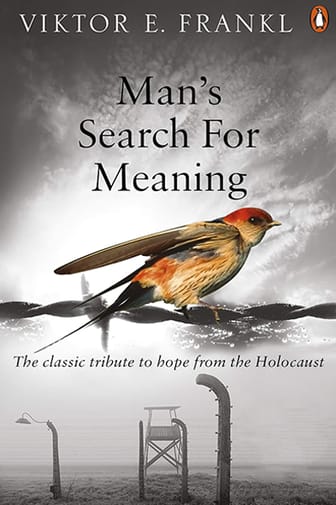
Man's Search for Meaning
By Viktor E. Frankl
Excerpt
Excerpt
“A thought transfixed me: for the first time in my life I saw the truth as it is set into song by so many poets, proclaimed as the final wisdom by so many thinkers. The truth—that love is the ultimate and the highest goal to which man can aspire. Then I grasped the meaning of the greatest secret that human poetry and human thought and belief have to impart: The salvation of man is through love and in love. I understood how a man who has nothing left in this world still may know bliss, be it only for a brief moment, in the contemplation of his beloved. In a position of utter desolation, when man cannot express himself in positive action, when his only achievement may consist in enduring his sufferings in the right way—an honourable way—in such a position man can, through loving contemplation of the image he carries of his beloved, achieve fulfilment. For the first time in my life I was able to understand the meaning of the words, ‘The angels are lost in perpetual contemplation of an infinite glory.’”
Essence
Essence
Meaning isn't yours to create – it's yours to discover in how you answer to life.
Viktor Frankl, an Austrian psychiatrist, survived four Nazi concentration camps and from this unimaginable suffering, forged a harrowing memoir and profound psychological treatise: Man’s Search for Meaning. The first part of the book recounts his lived experience of the camps with unflinching honesty – the physical brutality, the psychological stages of shock and apathy, and the observation that those with rich inner lives often endured better than those of robust constitution. The second part introduces logotherapy, his psychotherapeutic framework positioning the search for meaning as humanity's primary drive. In a world increasingly characterised by what Frankl termed the "existential vacuum," this modern classic offers both inspiration and a practical framework for addressing modern psychological suffering.
Embodiment: Living the Wisdom
Embodiment: Living the Wisdom
In Man's Search for Meaning, Viktor Frankl's lived experience of the Holocaust is the stark and confronting context of his teaching. Set in the most extreme of circumstances, what emerges is a man taking up responsibility for his response to life. It was, he describes, through acts little and large that – as a prisoner with nothing else left to him – he retained and asserted his freedom: small gestures of generosity, humour used as "the soul's weapon," and love discovered as the ultimate human aspiration even in conditions of absolute desolation.
While none of us can always control what happens to us, Frankl reminds us that we retain the fundamental freedom to choose our stance. In the camps, he witnessed this truth directly: those who survived longest were often those who connected with purpose beyond immediate suffering, who could “retreat from their terrible surroundings to a life of inner riches and spiritual freedom.”
The path to living this wisdom lies in recognising that life questions us – not the other way around. Each moment presents a situation asking for our response, and we answer through three categories:
- Attitudinal values: Choosing our stance toward unavoidable suffering
- Creative values: Contributing something meaningful through our work or deeds
- Experiential values: Opening to what life offers – truth, beauty, love
For Frankl, our answer to life’s demands must consist not just of talk and meditation, but in right action and conduct. As he experienced, “what man actually needs is not a tensionless state but rather the striving and struggling for a worthwhile goal”. Put another way, we grow stronger through meaningful challenges, like an architect who strengthens a decrepit arch by increasing the load upon it:
“The experiences of camp life show that man does have a choice of action. There were enough examples, often of a heroic nature, which proved that apathy could be overcome, irritability suppressed. Man can preserve a vestige of spiritual freedom, of independence of mind, even in such terrible conditions of psychic and physical stress.”
Frankl's central insight – that meaning is not ours to create but to discover through attunement to life – transforms suffering from something to be merely endured into an invitation to become more fully human. It is this reframing, forged in the darkest of circumstances, that makes the book so much more than a memoir of survival. With its accompanying explanation of logotherapy – the psychological framework developed by Frankl – Man’s Search for Meaning offers practical wisdom on how to cultivate hope and freedom while meeting whatever life asks of any of us, on whatever terms we're given.
“We who lived in concentration camps can remember the men who walked through the huts comforting others, giving away their last piece of bread. They may have been few in number, but they offer sufficient proof that everything can be taken from a man but one thing: the last of the human freedoms—to choose one's attitude in any given set of circumstances, to choose one's own way.”

“Everything can be taken from a man but one thing: the last of the human freedoms—to choose one's attitude in any given set of circumstances, to choose one's own way.”