Title details
Original Publication Date:2010
Edition Reviewed:Conscious Living Publications, 2010
Print Length:32 pages
Image Credit:Fiammetta Dogi
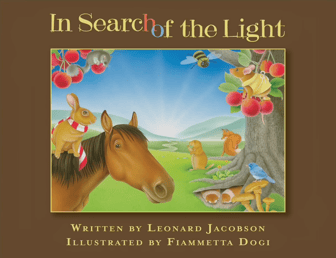
In Search of the Light
By Leonard Jacobson
Excerpt
Excerpt
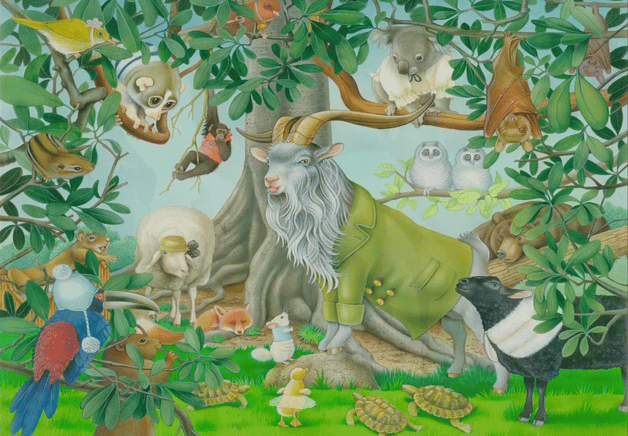
“There had been an eclipse of the sun. The day turned suddenly into night. The animals could not understand what had happened to the light…
A panic surged through the crowd.
‘Oh no!’ said the doe.
‘What now?’ called a cow.
‘I fear the very worst,’ a little deer loudly cursed.
‘What shall we do?’ asked the cockatoo.
‘We’re out of luck,’ replied a duck.
‘I hate the dark!’ chirped a lark.
‘I hate the dark! I hate the dark!’
And then a loud voice near the rear
called out for all to hear.
‘We must not accept our plight.
We must go off in search of light.’
They all agreed.
‘Of course! Of course.’
And all heads turned to Ned the horse.”
Essence
Essence
The light we seek is not found by running from darkness – it is discovered in the stillness of accepting what is, here and now.
In Search of the Light is Leonard Jacobson’s first children’s book, bringing his teaching on Presence to young readers through the story of four animal friends – Ned the Horse, Peter Rabbit, Bert the Bumblebee, and Molly Mouse – who set off through a dark forest after an eclipse plunges their world into night. Guided by wise characters they meet along the way, the friends journey through the “forest of fear” only to discover a profound truth: the light they seek is not found by choosing between “the easy way” or “the hard way,” but by walking “in between…the middle path,” beyond all desire and fear, “right now, right here.” Through lyrical storytelling and Fiammetta Dogi’s luminous illustrations, Jacobson shows children how the quest for an external light becomes an awakening to the light within.
Target Age: From 4 years onwards.
Embodiment: Living the Wisdom
Embodiment: Living the Wisdom
This children’s story unfolds as spiritual allegory. The eclipse – the sudden loss of light – represents the human condition of separation from Presence, from “the source of the light.” The animals’ immediate panic mirrors our habitual response to darkness, difficulty, or the unknown: fear, complaint, and the compulsion to “go off in search of light” somewhere else, sometime else. Yet their journey is not outward but inward, not forward but in between, into the very thing they fear.
Early on, the friends enter “the forest of fear,” encountering “strange images come to life behind every tree…cobwebs and spiders, snakes and rats…witches and ghosts hiding in shadows.” This is the landscape of the conditioned mind: the phantoms, projections, and imagined terrors that arise when we are not present. Jacobson shows children (and adults) that fear is the price we pay for leaving the present moment and dwelling in the past or the future.
The turning point comes when Bert the Bumblebee observes: “Nothing is like it’s supposed to be.” This simple statement captures the root of human suffering – resistance to what is. Later, facing signs pointing to “THE EASY WAY” and “THE HARD WAY,” a bird teaches them the path of opposites: “If you choose easy, it’s sure to get hard… If you won’t accept darkness, you won’t find the light.” The dualistic mind creates the very suffering it seeks to escape.
When Molly Mouse asks the question “What if we don’t choose?” the bird reveals the secret: “Ah, then you walk in between. From there, everything can be seen. There’s no judgment. No right or wrong. It’s the middle path you’d be walking along.” This is Jacobson’s teaching of Presence for children – the middle way beyond preference, beyond the mind’s endless choosing. “When you’ve been everywhere else, then you will know that no-where is the only place left to go. When you’re beyond all desire and beyond all fear, you’ll find the light. Right now. Right here.”
The story ends where the search began – in the meadow of ordinary life, now transfigured. “We’ve found it! We’ve found it!” they all cried. The light was never lost; it simply awaited their return to Presence. “Just one last word,” said the bird, “before you return to the meadow…Remember if you’re not in the center at the source of the light, then you’re standing in your own shadow.” Jacobson’s final teaching is that we cast our own darkness when we leave the now. The light is always here; we are either in it or standing in our own way.
For anyone seeking to introduce children to mindfulness and Presence, this story offers a gentle, joyful invitation into the now. And for those adults who want to embody these teachings on Presence, Leonard Jacobson offers online and in-person gatherings, teaching sessions, workshops, and residential retreats in the United States, Europe, Australia, and Asia. See his website and his YouTube channel for more information.

“The greatest gift you can bring to a child is the gift of Presence.”