Title details
Original Publication Date:1995
Edition Reviewed:Ballantine Books, 1995
Editor:Lucinda Vardey
Print Length:240 pages
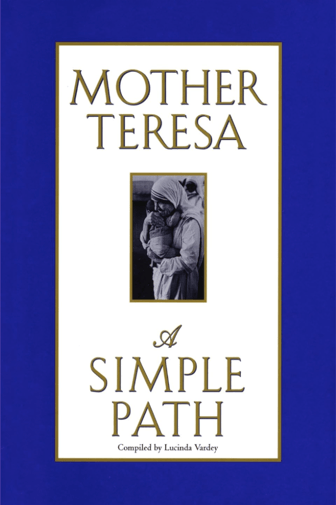
A Simple Path
By Mother Teresa
Excerpt
Excerpt
“The greatest disease in the West today is not TB or leprosy; it is being unwanted, unloved, and uncared for. We can cure physical diseases with medicine, but the only cure for loneliness, despair, and hopelessness is love. There are many in the world who are dying for a piece of bread but there are many more dying for a little love. The poverty in the West is a different kind of poverty – it is not only a poverty of loneliness but also of spirituality. There’s a hunger for love, as there is a hunger for God. [...]
When you know how much God is in love with you then you can only live your life radiating that love. I always say that love starts at home: family first, and then your own town or city. It is easy to love people who are far away but it is not always so easy to love those who live with us or right next to us. I do not agree with the big way of doing things – love needs to start with an individual. To get to love a person, you must contact that person, become close. Everyone needs love. Everyone must know that they’re wanted and that they are important to God.”
Essence
Essence
The simplest path to peace begins in silence.
The Albanian nun Anjezë Gonxhe Bojaxhiu, better known as Mother Teresa, stands as one of the most venerated figures of the twentieth century. A Simple Path acts as a carefully curated collection of her core teachings, distilling a starkly simple yet radically demanding vision of spirituality lived in action: holiness is found not in grand achievements or lofty ideas, but in small acts of love offered wholeheartedly in everyday life. The book teaches that peace begins at home, grows through humble service, and is sustained by a deep life of prayer that keeps one rooted in love for God and neighbour. Suffering is not romanticised but met with tenderness, presence, and compassion, especially in those who are forgotten or unwanted. The central message is that each person, no matter how limited their circumstances, can become a channel of divine love by doing ordinary things with extraordinary care. True transformation of the world does not begin with power or strategy but with a heart willing to love one person at a time.
Embodiment: Living the Wisdom
Embodiment: Living the Wisdom
Mother Teresa kept few possessions, but something she always kept on hand was a set of small yellow ‘business cards’ that read, “The fruit of silence is prayer, the fruit of prayer is faith, the fruit of faith is love, the fruit of love is service and the fruit of service is peace.” For her, this was the simple path – no more, no less – and it forms the very structure of the book itself. Each step is necessary to fully embody the next; thus, as you grow in one step, the next one naturally emerges in your heart, leading to a life of joy, love, and peace.
The first step, then, is silence. She explains, "I always begin my prayer in silence, for it is in the silence of the heart that God speaks. God is the friend of silence—we need to listen to God because it's not what we say but what He says to us and through us that matters." Silence, in this sense, is the condition in which prayer arises — a receptive stillness that lets us listen rather than only speak. Prayer follows naturally from it, and Mother Teresa treats it as being as necessary to the spirit as food is to the body, drawing us away from the busyness of the world and into the restful presence of God. She encourages this to be practised communally too, especially with family and with those of other religious paths.
From prayer, faith grows. "Take from my heart all guile and worldliness, that with the simple faith of a child, I may rely on You." The more we pray, she suggests, the more we recognise our daily reliance on the Divine — and it's this faith that opens us to loving others unconditionally: "When you know how much God is in love with you then you can only live your life radiating that love." That love, in her teaching, is not radiated half-heartedly: "Love until it hurts." However taxing this sounds, she frames it as nothing compared to the freedom found in a life of charity.
For Mother Teresa, love is only love when it is embodied in service. And the ultimate result of our service is that we find we have truly liberated ourselves along the way. In setting ourselves free from the cares and worries fuelled by selfish desire, we discover that true joy is found not in material gain but spiritual fullness: “We have a right to be happy and peaceful. We have been created for this—we are born to be happy—and we can only find true happiness and peace when we are in love with God.”
A Simple Path teaches that “Prayer in action is love, and love in action is service.” From a recipient of the Nobel Peace Prize, this might feel like a call to grand gestures, but Mother Teresa consistently counsels otherwise: small, immediate acts of unconditional love are what is called for, and the fruit of this service will be peace.

“Love has no meaning if it isn’t shared. Love has to be put into action. You have to love without expectation, to do something for love itself, not for what you may receive. If you expect something in return, then it isn’t love, because true love is loving without conditions and expectations.”